Where to Go for Gorilla Trekking in Africa?
Gorilla trekking in Africa can be done in the three East African countries of Uganda, Congo, and Rwanda. Uganda, Rwanda, the Democratic Republic of Congo, and the Republic of Congo each offer a version of this experience, and the four versions are different enough from each other that choosing between them is a real decision rather than a formality.
Two of the countries hold mountain gorillas. Two hold lowland gorillas, a different subspecies entirely, in a different kind of forest, with a different physical character to the trek and the encounter itself. This guide covers all four gorilla trekking destinations in detail.
Uganda
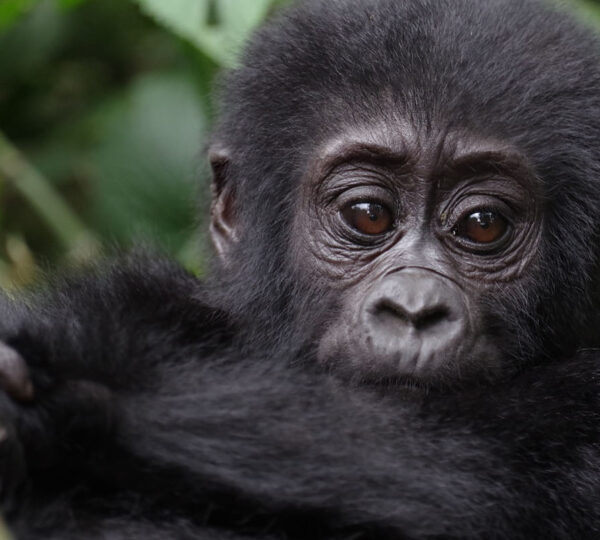
Uganda holds mountain gorillas in two separate national parks: Bwindi Impenetrable National Park, which has approximately 22 habituated gorilla families spread across four sectors, and Mgahinga Gorilla National Park, which has a single habituated family, the Nyakagezi group, on the slopes of the Ugandan side of the Virunga volcanoes. Between the two, Uganda holds roughly half of the world’s mountain gorilla population and issues the largest number of gorilla trekking permits of any country: up to 160 permits per day across Bwindi’s habituated families alone.
Bwindi Impenetrable National Park
Cost and Permits
A standard Uganda gorilla trekking permit costs USD 800 per person for foreign non-residents, USD 700 for foreign residents holding a valid work permit, and UGX 300,000 for East African Community citizens.
This makes Uganda significantly more affordable than Rwanda while still delivering essentially the same core experience: guided tracking, a habituated gorilla family, and a full hour in their presence. Uganda also offers the Gorilla Habituation Experience, available only in the Rushaga sector of Bwindi, which gives four hours with a semi-habituated family alongside researchers for USD 1,500 per person, a genuinely different and deeper experience from the standard hour.
Getting There and What to Combine It With
Bwindi and Mgahinga are both an eight to ten-hour road journey from Entebbe International Airport, which is Uganda’s main disadvantage relative to Rwanda’s much shorter transfer time. Most visitors break this drive with a stop at Queen Elizabeth National Park or Murchison Falls National Park, which turns the gorilla trek into the centrepiece of a broader one to two-week Uganda safari rather than a standalone add-on.
A scheduled light aircraft flight from Entebbe to an airstrip near Bwindi, followed by a shorter road transfer, is available for visitors who want to reduce the travel time without giving up the wider Uganda safari. This is Uganda’s real advantage over Rwanda: the ability to combine gorillas with chimpanzee trekking in Kibale, tree-climbing lions in Queen Elizabeth’s Ishasha sector, the Nile boat cruise at Murchison Falls, and over 1,080 recorded bird species, all without leaving the country.
Accommodation
Uganda’s accommodation near Bwindi ranges from budget guesthouses at USD 30 to 100 per night to luxury properties like Clouds Mountain Gorilla Lodge and Sanctuary Gorilla Forest Camp that rival anything in Rwanda. The broader spread of price points, combined with lower permit costs, makes Uganda the destination most safari planners point to when a client asks how to see gorillas without paying the premium that Rwanda’s luxury-first tourism model commands.
Rwanda
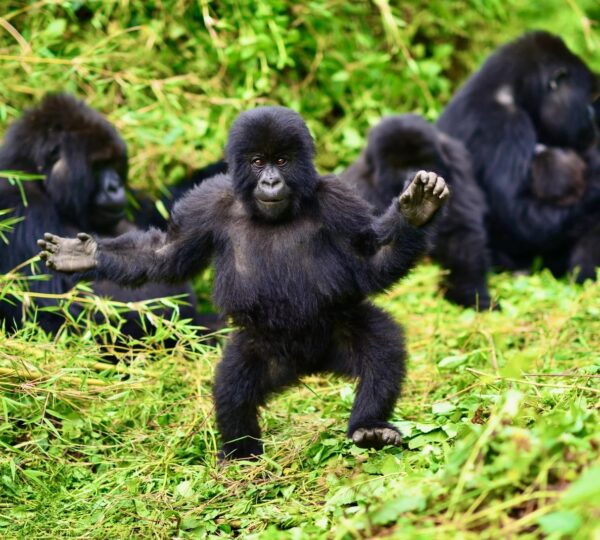
Rwanda’s gorilla trekking happens exclusively in Volcanoes National Park in the country’s northwest, part of the same Virunga Massif that Uganda’s Mgahinga sits on. The park holds around ten to twelve habituated gorilla families, and Rwanda’s approach to tourism generally, described by the government as high-value, low-volume, shapes every part of the gorilla trekking experience from the road quality to the lodges to the crowd size at the briefing point.
Volcanoes National Park
Cost and Permits
A Rwanda gorilla trekking permit costs USD 1,500 per person for international visitors, nearly double Uganda’s rate, and the premium is a deliberate policy choice rather than a market accident. Rwanda has decided to attract fewer, higher-spending visitors rather than compete on volume, and the permit price, the luxury lodge concentration, and the generally smoother logistics all follow from that decision. A portion of the permit fee funds conservation and community development directly, and Rwanda’s gorilla population, part of the shared Virunga total, has benefited from this funding model.
Getting There and What to Combine It With
This is Rwanda’s standout advantage. Volcanoes National Park is two to three hours by road from Kigali International Airport, which means a same-day arrival and trek is technically possible and a short two to four-day gorilla-focused trip is entirely practical for visitors who cannot commit to a longer safari. Rwanda also offers golden monkey trekking in the same park, the Dian Fossey grave and Karisoke Research Centre hike, and volcano hikes up Mount Bisoke, all without leaving the immediate area. For a broader trip, Nyungwe Forest National Park adds chimpanzee trekking and Akagera National Park adds a proper Big Five savannah safari, both within a few hours’ drive.
Accommodation
Rwanda’s lodge scene near Volcanoes National Park is the most concentrated cluster of world-class luxury properties anywhere in the gorilla trekking world: Bisate Lodge, Singita Kwitonda Lodge, One&Only Gorilla’s Nest, and Wilderness Bisate Reserve are all within a short drive of the park headquarters at Kinigi. Rwanda does have mid-range and budget options, but the country’s tourism strategy skews the overall accommodation mix toward the top end far more than Uganda’s does.
Democratic Republic of Congo
The DRC offers gorilla trekking in two separate parks holding two separate subspecies. Virunga National Park, Africa’s oldest national park and part of the same Virunga Massif as Rwanda’s Volcanoes and Uganda’s Mgahinga, holds habituated mountain gorilla families. Kahuzi-Biega National Park, further south near Bukavu, holds eastern lowland gorillas, the largest gorilla subspecies in the world and one found nowhere else.
Cost and Permits
DRC permits are the most affordable mountain gorilla option available: approximately USD 400 per person in Virunga National Park, roughly half of Uganda’s price and a quarter of Rwanda’s. Kahuzi-Biega’s eastern lowland gorilla permits are similarly priced. For budget-conscious travellers who are comfortable with the additional logistical and security planning the DRC requires, this is the most affordable way to see either mountain gorillas or a unique, nowhere-else-on-earth lowland gorilla subspecies.
Republic of Congo
The Republic of Congo, not to be confused with its much larger neighbour the DRC, offers an entirely different gorilla trekking experience built around western lowland gorillas in the equatorial rainforest of Odzala-Kokoua National Park. This park covers 13,500 square kilometres of largely undisturbed rainforest and is one of the most significant strongholds for western lowland gorilla conservation anywhere in the world, alongside a rich broader mammal community of roughly 100 species.
What Makes the Trekking Different
The single biggest difference between Congo and the mountain gorilla countries is how the trek itself begins. In Uganda and Rwanda, visitors take a road transfer from the lodge to a park headquarters, get briefed, and then drive again to a trailhead before starting a hike that can run to several hours. In the Republic of Congo, you and your guide can walk directly into the forest from camp and start searching for gorillas immediately, sometimes finding a family within an hour. The flatter, lower-altitude terrain also means warmer conditions than the cold Virunga slopes or Bwindi’s high-altitude forest.
Congo also permits trekking on three consecutive days at some camps, compared to the single day allowed in Uganda, Rwanda, and generally in the DRC. This gives visitors the chance to spend real time with more than one gorilla family and to observe the differences in personality and group dynamics between families, an opportunity that the one-visit model elsewhere simply does not allow. Because Congo’s tourism numbers are lower and the trekking groups smaller, past visitors consistently describe the experience as quieter and more intimate, with fewer people photographing at once and a better unobstructed view of the animals.
Gorilla Trekking Destinations Compared
| Destination | Gorilla Subspecies | Permit Cost (Non-Resident) | Trek Character |
| Uganda (Bwindi) | Mountain gorilla | USD 800 | Steep, dense, physically demanding, 1–8 hours |
| Uganda (Mgahinga) | Mountain gorilla | USD 800 | Volcanic slopes, single family, occasional cross-border unavailability |
| Rwanda (Volcanoes) | Mountain gorilla | USD 1,500 | More open bamboo forest, generally shorter treks |
| DRC (Virunga) | Mountain gorilla | ~USD 400 | Similar terrain to Rwanda side of Virungas, lower cost |
| DRC (Kahuzi-Biega) | Eastern lowland gorilla | ~USD 400 | Lower altitude, gentler terrain, unique subspecies |
| Republic of Congo (Odzala) | Western lowland gorilla | Fly-in package pricing | Flat, warm rainforest, trek starts from camp, up to 3 consecutive days |
How to Choose Between Them
Choose Uganda If…
- You want the lowest-cost mountain gorilla permit with the widest permit availability and the most habituated families to choose from
- You are building a broader Uganda safari and want chimpanzees, tree-climbing lions, the Nile, and world-class birdwatching in the same trip
- You are comfortable with, or specifically want, a more physically demanding trek through dense forest
- You have at least a week to spend in the country, since the distance from Entebbe to Bwindi rewards a longer stay
Choose Rwanda If…
- You have limited time and want the shortest possible transfer from an international airport to the trailhead
- You prioritise luxury accommodation, polished logistics, and a lower-crowd, high-value tourism model
- You want a gentler trek, or are travelling with older family members or anyone with moderate fitness concerns
- You want to combine gorillas with golden monkey trekking, a volcano hike, or a short add-on to Nyungwe or Akagera
Choose the DRC If…
- Cost is the primary factor and you are comfortable with a more unpredictable security and logistics environment
- You specifically want to see the eastern lowland gorilla, found nowhere else on earth, at Kahuzi-Biega
- You are an experienced Africa traveller who has likely already done Uganda or Rwanda and wants something rawer
- You are booking through an operator with verified, current, on-the-ground security knowledge of the region
Choose the Republic of Congo If…
- You want western lowland gorillas specifically, a genuinely different subspecies and forest type from anything in East Africa
- You want multiple consecutive days with gorilla families rather than a single one-hour visit
- You prioritise an intimate, low-crowd rainforest experience over convenience or budget
- You have the time and budget for the more involved fly-in logistics via Brazzaville
Best Time to Go Gorilla Trekking
Across all four countries, the dry seasons offer the most comfortable trekking conditions. In East Africa, that means June through September and December through February, when trails are firmer and less muddy and the forest is easier to move through.
The Republic of Congo’s dry season runs similarly from June through September with a shorter dry spell in January and February, while its wetter months fall between October and December and March through April.
Gorilla trekking itself is not seasonal in the way that some wildlife events are: the gorillas are resident year-round in all four countries and do not migrate, so a wet-season trek is entirely possible and often significantly cheaper and less crowded. The trade-off is muddier, more slippery trails, which particularly affects Uganda’s already steeper Bwindi terrain.
For a first-time trekker who wants the most comfortable physical conditions, the dry season is worth prioritizing. For a repeat visitor or a more experienced hiker who wants lower prices and quieter trails, the wet season is a genuine and often underrated option.