
Mount Elgon National Park: The Complete Guide to Hiking Uganda’s Gentlest Giant
Mount Elgon sits in eastern Uganda on the Kenyan border, roughly 235 kilometres and a four- to five-hour drive from Kampala, most commonly reached via the town of Mbale. It’s a natural stop for travellers heading toward Kenya overland, or those exploring eastern Uganda separately from the western gorilla and savanna circuit. The specific trailhead town depends on the route: Budadiri for the Sasa Trail, Kapkwai for the Sipi Trail, Kapkwata for the Piswa Trail, and Bududa for the newer Bushiyi Trail.
Why Visit Mount Elgon
The caldera is the park’s defining feature, a crater roughly 40 square kilometres at its summit, ringed by peaks including Wagagai, the mountain’s highest point at 4,321 metres and, at various points in history, considered the eighth-highest peak on the continent.
Unlike the Rwenzoris’ glaciated, technical terrain, Mount Elgon’s trails are graded and largely non-technical, making a genuine multi-day summit trek achievable for fit hikers without specialised climbing experience.
Sipi Falls, on the mountain’s lower northeastern slopes, adds a second, entirely different draw: three cascading waterfalls dropping between 65 and 100 metres, surrounded by terraced coffee farms and small guesthouses that have made the area a popular stop even for travellers with no interest in a multi-day hike.
Between the falls, the caldera’s hot springs and caves, and strong birding throughout, Mount Elgon rewards both the serious trekker and the traveller who just wants a scenic day or two.
When to Go: Best Time to Visit Mount Elgon
As with most Ugandan highland trekking, June through August offers the firmest trails and clearest views from the caldera rim, making it the preferred window for anyone attempting one of the multi-day summit routes. December through February provides a comparable dry-season alternative with good visibility and slightly cooler, crisper mornings on the mountain.
The long rains, March through May and heaviest in April, make the upper trails muddy and slippery, and most operators recommend against attempting a summit trek during this stretch. October and November bring shorter, less predictable rain that can still disrupt a multi-day itinerary.
Sipi Falls, being a shorter and lower-elevation visit, is far more weather-tolerant than the summit routes and remains worth visiting in any season, with the falls arguably at their most dramatic and full-flowing just after a rain shower.
| Season | Months | What to Expect |
| Long dry season | June – August | Best trekking conditions, clearer summit views |
| Short dry season | December – February | Good visibility, firmer trails |
| Long rains | March – May | Heaviest rain in April; trails become muddy and slippery |
| Short rains | October – November | Intermittent showers, less predictable |
As with most Ugandan highland trekking, the dry months from June to August and December to February offer the firmest trails and clearest views from the caldera rim. Sipi Falls, being a shorter, lower-elevation visit, is more weather-tolerant and worth visiting in any season, though the falls are at their most dramatic just after rain.
Budget Guide: What Mount Elgon Costs
| Item | Approximate Cost (Foreign Non-Resident) | Notes |
| Park entrance fee | $35 per person, per 24 hours | Confirm current UWA rate when booking |
| Multi-day hiking package (Sasa, Piswa, Sipi or Bushiyi trail) | $500–1,200 per person | Includes guides, porters, camping and park fees; varies by route length and group size |
| Sipi Falls guided walk | $20–30 per person | No park permit required, arranged locally |
| Rock climbing or abseiling at Sipi | $40–70 per person | Half-day sessions, various operators |
Mount Elgon’s multi-day treks are notably more affordable than equivalent Rwenzori packages, reflecting the shorter routes and less technical support required. Prices generally fall as group size increases, since guide, porter and camping costs are shared across more people.
Where to Stay Around Mount Elgon
| Tier | Example Style | Best For |
| Luxury | Boutique lodges overlooking Sipi Falls | Travellers prioritising scenery and comfort |
| Mid-range | Comfortable guesthouses and cottages near Sipi or Mbale | Most visitors |
| Budget | Backpacker guesthouses and campsites | Independent and budget travellers |
| Trek accommodation | Campsites along the hiking trails | Multi-day trekkers |
Top Attractions at Mount Elgon
The caldera is Mount Elgon’s defining geological feature, an enormous crater left behind by the extinct volcano, and it’s considered the largest intact example of its kind anywhere on earth. Wagagai Peak, the mountain’s highest point at 4,321 metres, rises from the caldera rim and is the objective for trekkers attempting the summit routes, though the crater floor itself, scattered with hot springs and caves, is worth exploring in its own right for hikers who reach it.
On the mountain’s lower northeastern slopes, well outside the multi-day trekking zone, Sipi Falls has become one of Uganda’s most photographed landscapes: three cascading waterfalls dropping between 65 and 100 metres through a landscape of terraced Arabica coffee farms. It’s entirely possible to visit Sipi without any interest in the summit trek, and many travellers do exactly that. The wider park supports over 300 recorded bird species, including the sought-after Jackson’s francolin, giving Mount Elgon a genuine birding appeal alongside its geology and hiking.
| Attraction | Description |
| Mount Elgon caldera | The largest intact volcanic caldera on earth |
| Sipi Falls | Three cascading waterfalls just outside the park, dropping 65–100 metres |
| Wagagai Peak | The mountain’s highest point, at 4,321 metres |
| Hot springs and caves | Geothermal springs and caves scattered across the caldera floor |
| Birdlife | Over 300 species, including Jackson’s francolin |
Things to Do at Mount Elgon
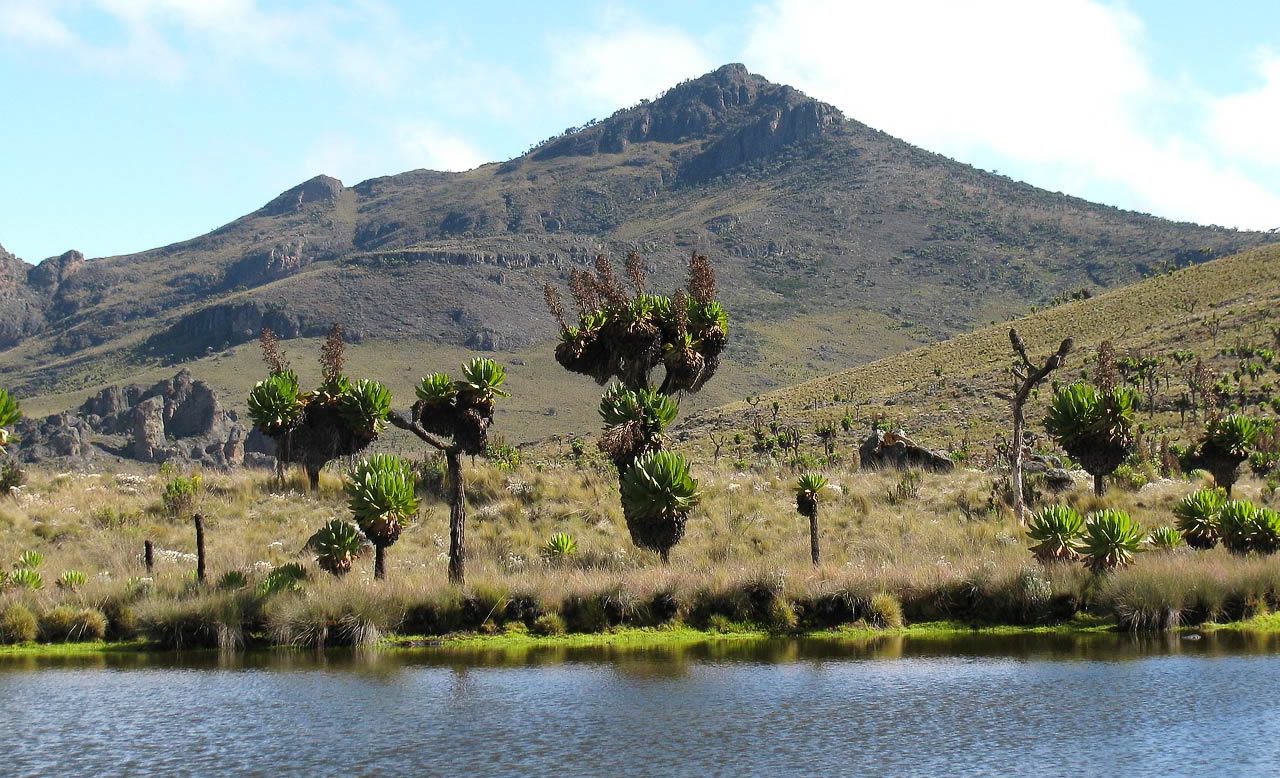
Hiking and trekking form the core of a Mount Elgon visit for anyone attempting the summit, with four established routes offering genuinely different experiences. The Sasa Trail is the shortest and steepest, typically covered in three to four days, a demanding option for hikers with limited time who can handle a direct ascent; the Piswa Trail is the longest but gentlest, taking around six to seven days and approaching from the north through bamboo forest and open moorland with views toward the Karamoja plains; the Sipi Trail spans four to six days along a more gradual, scenic route past the falls themselves; and the newer Bushiyi Trail, from the park’s southern side near Bududa, offers the fastest route to the summit for hikers who can manage its steep, direct ascent, and is now sometimes combined with a Sasa Trail descent as a single circuit. None of these routes require the technical glacier skills that the Rwenzoris demand, making Mount Elgon a genuinely achievable summit for fit, well-prepared hikers without prior mountaineering experience.
Mount Elgon National Park
| Activity | Description |
| Hiking and trekking | Sasa Trail (3–4 days, steepest), Piswa Trail (6–7 days, gentlest), Sipi Trail (4–6 days, scenic) or Bushiyi Trail (fastest ascent, southern side) |
| Rock climbing and abseiling | Guided sessions at Sipi Falls for varying skill levels |
| Birdwatching | Guided walks through montane forest and moorland |
| Cave exploration | Visits to caves within the caldera and lower slopes |
| Cultural tours | Visits to Sipi’s coffee-growing communities and local traditions |
| Mountain biking | Trails around the Sipi Falls area |
Planning Advice for Mount Elgon
If a full summit trek isn’t in your plans, a two-day stop at Sipi Falls alone delivers strong scenery, waterfall hikes and optional abseiling without any park permit.
Choose your trail based on time available: the Sasa or Bushiyi trails are the shortest but steepest, while the Piswa or Sipi trails offer a more gradual, scenic approach across a longer distance.
Pack for cold nights on the caldera rim even though the trailhead sits in comfortable, temperate lowland conditions.
Combine a Sipi Falls stop with the local coffee tours; the region is a genuine Arabica coffee-growing area and tours are widely available.
Consider Mount Elgon as an eastern Uganda add-on if you’re also visiting Kenya overland, since it sits directly on that route.
Who Mount Elgon Is Best For
Mount Elgon suits hikers who want a genuine multi-day trekking challenge without the technical demands or cost of the Rwenzoris, as well as travellers who simply want a scenic, relaxed stop at Sipi Falls with light activity options like short walks or abseiling. It’s a strong choice for eastern Uganda itineraries or as an overland stop en route to Kenya, though it’s less commonly combined with the western gorilla and savanna circuit given the distance between the two regions.
Frequently Asked Questions
Do I need to be an experienced climber to summit Mount Elgon?
No. The trails are graded and non-technical, making the summit achievable for fit, prepared hikers without prior mountaineering experience, unlike the more technical routes in the Rwenzoris.
Is Sipi Falls worth visiting without doing the full trek?
Yes. Sipi Falls is a standalone destination in its own right, with waterfall walks, coffee tours and abseiling available without a multi-day commitment or park entrance fee.
How does Mount Elgon compare to the Rwenzoris?
Mount Elgon is gentler, cheaper and shorter to trek, without glaciers or technical climbing sections, while the Rwenzoris offer a more demanding, higher-altitude glaciated experience.
Which trail should I choose?
The Sasa or Bushiyi trails suit hikers with limited time who can handle a steep ascent; the Sipi Trail suits those wanting a longer, more gradual and scenic route; the Piswa Trail is the gentlest and quietest, with the most solitude.
Can I visit Mount Elgon as a day trip from Mbale?
Sipi Falls, yes. The summit caldera hike requires a multi-day commitment and cannot realistically be done as a day trip.
Is Mount Elgon suitable for families?
Sipi Falls and short local walks are family-friendly; the multi-day summit treks are better suited to older teenagers and adults given the distances and camping involved.