Bwindi Impenetrable Forest National Park : A Complete Guide to Gorilla Trekking in Uganda
Bwindi is home to more than 20 habituated gorilla families spread across its four sectors, each accustomed to short daily visits from small groups of trekkers. Unlike a game drive, where an animal might be a silhouette at 200 metres, gorilla trekking puts you seven metres from a silverback contentedly eating wild celery, or watching juveniles wrestle in the undergrowth while their mother looks on with what can only be described as patience. Sightings succeed on the vast majority of treks, which is a remarkable statistic for any wild animal encounter.
But narrowing Bwindi down to “the gorilla park” undersells it. The forest itself is ancient, predating the last Ice Age, and its density and altitude range have produced a level of biodiversity that surprises most first-time visitors. Eleven other primate species live here alongside the gorillas, including black-and-white colobus monkeys that move through the canopy in loose, showy troops. Birders rate Bwindi among Africa’s finest forest birding sites, with 23 species found nowhere outside the Albertine Rift. And the Batwa, the forest’s original inhabitants, offer a cultural dimension that rounds out what would otherwise be a purely wildlife-focused stop.
The park rewards travellers who want one extraordinary, effortful experience rather than a checklist of animals seen from a vehicle. If that trade-off appeals to you, Bwindi belongs near the top of your Uganda itinerary.
Where Bwindi Is and How to Get There
Bwindi sits in Uganda’s far southwest, in Kanungu District, hard against the Democratic Republic of Congo border and not far from Rwanda. The park is split into four trekking sectors — Buhoma in the north, Ruhija in the east, and Rushaga and Nkuringo in the south — and which one you fly or drive into depends on which sector your permit is allocated to.
Most travellers reach Bwindi by road from Entebbe or Kampala, a journey of roughly 8 to 9 hours that’s usually broken into a two-day drive with a stopover at Lake Mburo or Queen Elizabeth National Park along the way. For those short on time, scheduled and chartered flights connect Entebbe to airstrips at Kihihi (serving Buhoma) and Kisoro (serving Rushaga and Nkuringo), cutting the journey to about an hour and a half. Given how much of a Uganda safari’s total travel time Bwindi can consume by road, flying in is worth the extra cost for anyone combining the park with a tight itinerary.
When to Go: Best Time to Visit Bwindi
Uganda doesn’t have a truly bad season for gorilla trekking, since permits are issued year-round and the forest is beautiful whatever the weather. But rainfall changes the experience meaningfully, because trails get steeper and slicker underfoot when the ground is saturated, so it helps to understand what each season actually feels like rather than just picking dates off a calendar.
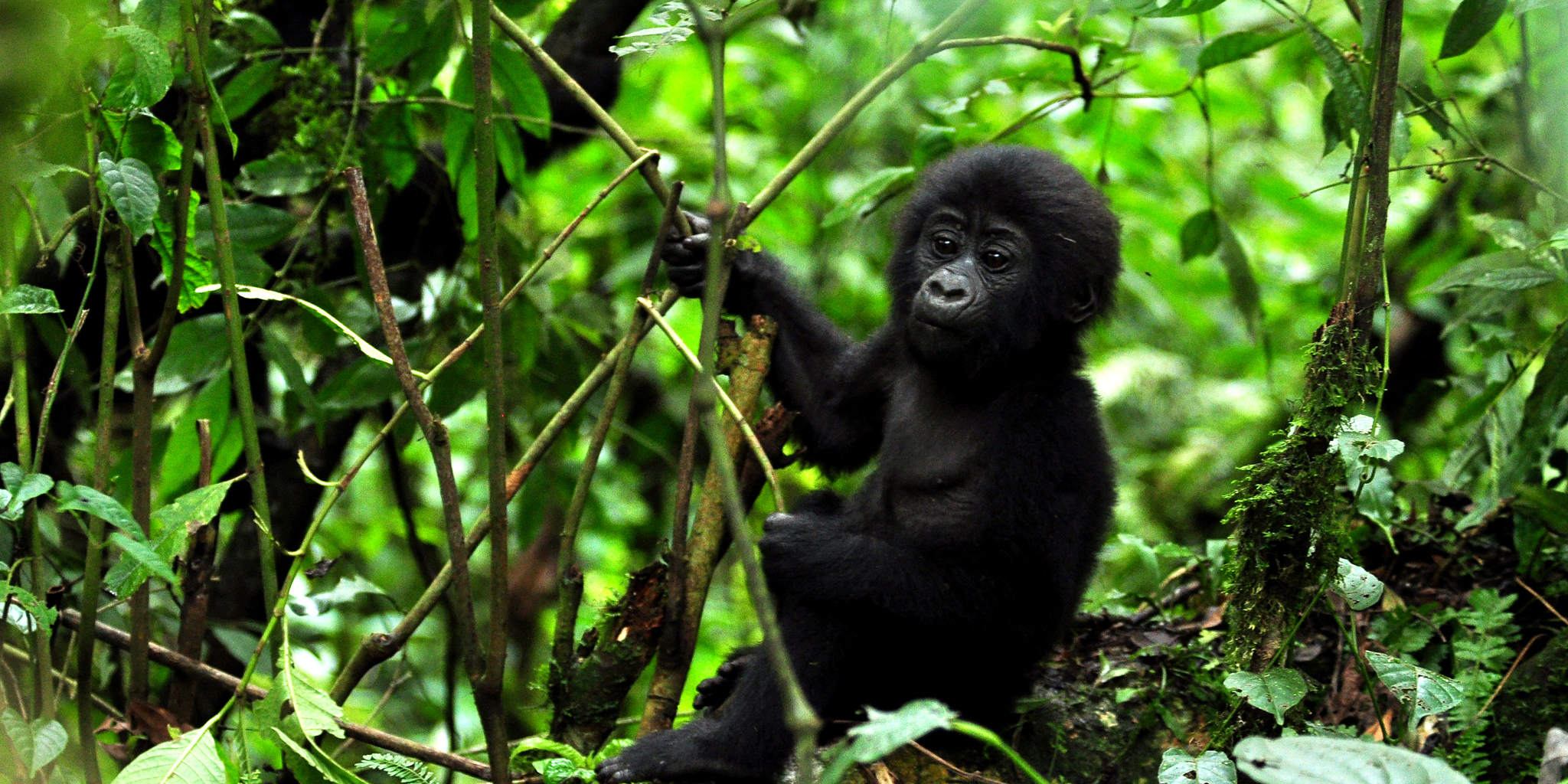
Baby Gorilla
June through August is Bwindi’s long dry season and its busiest booking window, when trails are at their firmest and conditions are at their most predictable. Most first-time visitors choose this stretch, and it’s a safe default if a comfortable hike matters more to you than avoiding crowds, though it also means fuller lodges and earlier permit bookings. December through February brings a shorter dry spell that’s just as good for trekking but noticeably quieter, since it falls outside the main North American and European holiday season; February in particular tends to be reliably dry underfoot.
The long rains arrive from March through May, with April as the wettest month of the year across the whole country. Trails turn genuinely muddy during this stretch and treks can take longer as guides pick more careful routes, but permit demand drops and so do accommodation rates, and the forest itself is at its greenest. October and November bring a shorter, less predictable bout of rain; showers tend to be intense but brief, and most days still allow for a full trek.
| Season | Months | What to Expect |
| Long dry season | June – August | Firmer trails, the most popular and busiest booking window |
| Short dry season | December – February | Good trekking conditions, quieter than mid-year |
| Long rains | March – May | Heaviest rain in April; muddy trails but lower permit demand |
| Short rains | October – November | Unpredictable showers; good value and fewer crowds |
For most travellers, June through August or December through February offer the best balance of firm trails and manageable crowds. If you’re comfortable with mud and want lower rates on accommodation, the shoulder months of March, April, May and November can be excellent value, and gorilla permits are discounted to $600 for foreign non-residents during April, May and November.
Budget Guide: What Gorilla Trekking Costs
The gorilla permit is the single biggest line item in any Bwindi trip, and it’s worth understanding exactly what it buys before you budget the rest of the trip around it. A significant process change also took effect on March 1, 2026: the Uganda Wildlife Authority discontinued its old system of holding a permit for up to seven days without payment. Full payment is now required at the time of booking to confirm any date, and individual travellers can no longer book directly with UWA, all bookings must go through a licensed Ugandan tour operator.
| Item | Approximate Cost (Foreign Non-Resident) | Notes |
| Standard gorilla permit | $800 per person | High season; covers one trek, one hour with the gorillas |
| Low-season gorilla permit | $600 per person | April, May, November only; non-reschedulable |
| Gorilla habituation experience | $1,500 per person | Four hours with a semi-habituated group, limited to 4 guests daily, Rushaga sector only |
| Park entrance fees | Included in the permit price | Separate fee applies for non-trekking companions |
| Porter fee | $15–20 per person | Optional but strongly recommended, and supports local livelihoods |
Beyond the permit, budget for accommodation, a private vehicle or transfer, and a guide or tour operator if you’re not self-driving. A realistic all-in daily cost, including lodging and transport, ranges from around $250 a day for a budget setup to well over $1,000 a day at the top luxury lodges. Permit prices are set by the Uganda Wildlife Authority and revised periodically, so confirm current rates with your operator before booking, and book permits three to six months ahead for peak season since each gorilla family accepts only eight visitors a day.
Where to Stay: Accommodation Around Bwindi
Lodging is organised by trekking sector, and choosing where to stay effectively decides which sector — and which gorilla families — you’ll be trekking to.
| Tier | Example Style | Best For |
| Luxury | Forest-edge lodges with private verandas, spa facilities and fine dining, mostly in Buhoma and Nkuringo | Travellers prioritising comfort after a demanding trek |
| Mid-range | Comfortable en-suite cottages with forest or valley views | The majority of travellers, balancing comfort and cost |
| Budget | Simple guesthouses and community-run camps | Backpackers and those funnelling their budget into the permit itself |
Buhoma has the widest range of established lodges and the gentlest average trails, making it a popular first-timer’s choice. Rushaga, in the south, has the greatest concentration of habituated families and is the base for the habituation experience. Ruhija sits at higher altitude with cooler nights and excellent birding on the doorstep.
Top Attractions in Bwindi
Beyond the gorilla families that draw most visitors here, Bwindi rewards a slower, more curious look at the forest itself. The park protects one of Africa’s oldest rainforests, dating back more than 25,000 years, and its age shows in the density and tangle of the vegetation, exactly the quality that gives the park its name. Eleven other primate species share this forest with the gorillas, most visibly the black-and-white colobus monkeys that move through the canopy in loose, showy troops that are hard to miss even on a short walk.
Birders have particular reason to linger, since Bwindi’s altitude range and unbroken forest cover have made it one of Africa’s premier forest birding sites, with 23 species found nowhere outside the Albertine Rift. And running through all of it is the presence of the Batwa, the forest’s original inhabitants, whose displaced but still-vivid cultural heritage adds a human dimension to what would otherwise be a purely wildlife-focused stop.
| Attraction | Description |
| Mountain gorillas | Over 20 habituated families across the four trekking sectors |
| Ancient rainforest | One of Africa’s oldest forests, dating back more than 25,000 years |
| Eleven other primate species | Including black-and-white colobus and L’Hoest’s monkey |
| Birdlife | Over 350 species, including 23 Albertine Rift endemics |
| Batwa heritage | Cultural sites tied to the forest’s original inhabitants |
Things to Do in Bwindi
Gorilla trekking is the headline activity, but it’s worth understanding the full range of options before committing to just one. Standard trekking gives you a guided hike, anywhere from two to eight hours depending on where the gorillas have moved that morning, followed by a single precious hour in their company. Travellers who want more time, and don’t mind the extra fee, can opt for the gorilla habituation experience in the Rushaga sector, a four-hour visit with a semi-habituated troop capped at just four guests a day alongside the researchers working to acclimatise them.
Away from the primates, Bwindi rewards travellers willing to slow down further. Guided forest nature walks wind through the interior in search of birds, medicinal plants and the park’s other primates, while dedicated birdwatching walks target the Albertine Rift endemics that draw serious birders from around the world.
The Batwa cultural trail is a half-day experience led by Batwa community members themselves, offering insight into forest life before their displacement, and community village walks around Buhoma extend that same cultural thread into homesteads, schools and craft cooperatives. Shorter waterfall hikes near Buhoma round out the options for travellers wanting a lighter add-on between more demanding days.
| Activity | Description |
| Gorilla trekking | Guided hikes of 2–8 hours to visit a habituated family |
| Gorilla habituation experience | Extended four-hour visit with a semi-habituated troop |
| Guided forest nature walks | Trails through the forest interior for primates, birds and plants |
| Birdwatching | Specialist walks targeting Albertine Rift endemics |
| Batwa cultural trail | Half-day guided experience with Batwa community members |
| Community village walks | Visits to homesteads, schools and craft cooperatives near Buhoma |
| Waterfall hikes | Short trails to forest waterfalls near Buhoma |
Planning Advice for Bwindi
A few practical points make the difference between a trek that’s memorable for the right reasons and one that’s memorable for the wrong ones.
Book permits well ahead, and expect to pay in full at the time of booking rather than placing a temporary hold. Peak-season permits, especially for Rushaga’s habituation experience, sell out months in advance.
Train for the terrain, not just the distance. Bwindi’s trails involve real elevation change on uneven, sometimes muddy ground, and treks can run from two to eight hours depending on where the gorillas have moved.
Hire a porter. Beyond the practical help carrying your bag on steep sections, porter fees are a direct and meaningful contribution to the local economy.
Pack layered clothing, a rain jacket, gardening gloves for gripping vegetation, and sturdy waterproof boots with ankle support.
Build in a buffer day. If road transfers are involved, an unexpected delay shouldn’t cost you your trekking slot.
Who Bwindi Is Best For
Bwindi rewards travellers who are reasonably fit and genuinely excited by the idea of physical effort in exchange for an intimate wildlife encounter. Honeymooners and couples find the luxury lodges around Buhoma and Nkuringo well suited to a slower, more indulgent pace either side of the trek. Serious wildlife photographers and repeat safari-goers often opt for the habituation experience in Rushaga for the extra time with the gorillas.
Families with older, fit teenagers can trek successfully, though most operators set a minimum age of 15 for the activity itself. Travellers with significant mobility limitations should discuss options carefully with their operator, since the terrain doesn’t accommodate wheelchairs or those unable to hike for extended periods, though sedan chairs carried by porters are available for an additional fee.
Frequently Asked Questions
How fit do I need to be to trek gorillas in Bwindi?
You don’t need to be an athlete, but a reasonable baseline fitness helps considerably. Treks can last anywhere from two to eight hours over steep, uneven terrain, and porters are available to carry bags and offer a hand on difficult sections.
What’s the difference between gorilla trekking and the gorilla habituation experience?
Standard trekking gives you one hour with a fully habituated family. The habituation experience, offered only in Rushaga, gives you four hours with a group still being acclimatised to human presence, alongside researchers, for a higher fee and a smaller group size of four.
How far in advance should I book a gorilla permit?
Three to six months ahead for June to September and December to February. Shoulder-season permits can sometimes be secured with less notice. As of March 2026, full payment is required at the time of booking, and all permits must be arranged through a licensed tour operator rather than directly with UWA.
Can I combine Bwindi with gorilla trekking in Rwanda?
Yes, and many itineraries do, though Rwanda’s permits are considerably more expensive at $1,500 per person. Uganda offers the more affordable route to the same species.
Is Bwindi suitable for children?
Most operators require trekkers to be at least 15 years old, largely for the animals’ welfare and the physical demands of the hike, though non-trekking family members can enjoy nature walks and cultural activities instead.
What happens if we don’t find gorillas?
It’s rare, but the Uganda Wildlife Authority offers a free re-trek or partial refund in genuine no-sighting cases, subject to availability.