Guide to Private Tours in East Africa
Guide to Private Tours in East Africa; There’s a particular kind of freedom that comes with having your own vehicle, guide, and itinerary on safari: the freedom to linger at a sighting for forty-five minutes instead of ten because nobody else wants to move on, to sleep in an extra hour without holding up a group schedule, or to rewrite tomorrow’s plan entirely because your guide just heard a leopard has been active near a specific riverbed.
That flexibility is the entire premise of a private safari, and it’s worth understanding clearly what you’re actually paying for when you choose it over a shared group experience.
This guide covers what private touring in East Africa involves, what it costs relative to shared alternatives, and who genuinely benefits most from the investment.
Should You Book a Private Tour?
Private touring makes the most sense for travelers with specific priorities that a shared itinerary can’t accommodate: a milestone celebration, a particular photography interest, mobility considerations, a desire to move at your own pace, or simply the preference for privacy and control that some travelers value highly regardless of cost. It’s a less clear-cut choice for budget-conscious travelers with flexible interests who are equally happy following a well-designed shared itinerary, where a scheduled group departure often delivers comparable wildlife viewing at meaningfully lower cost.
We’d encourage you to think honestly about how much control actually matters to you personally, rather than assuming private is automatically the “better” or more premium choice in every case. Plenty of extraordinary safaris happen in shared vehicles.
What “Private” Means in Practice, Day to Day
It’s worth painting a concrete picture rather than leaving this abstract. On a private itinerary, your morning might start whenever you and your guide agree, rather than at a fixed departure time set for a full vehicle of guests. If a sighting is particularly good, your guide can simply stay, radioing camp to adjust your return time rather than needing to balance other guests’ schedules.
Lunch might happen back at camp, in the bush as a picnic, or be skipped entirely in favor of pushing on to a promising area, based purely on what you’d prefer that day. It’s this accumulation of small, continuous choices, more than any single dramatic difference, that defines what private touring actually feels like once you’re on the ground.
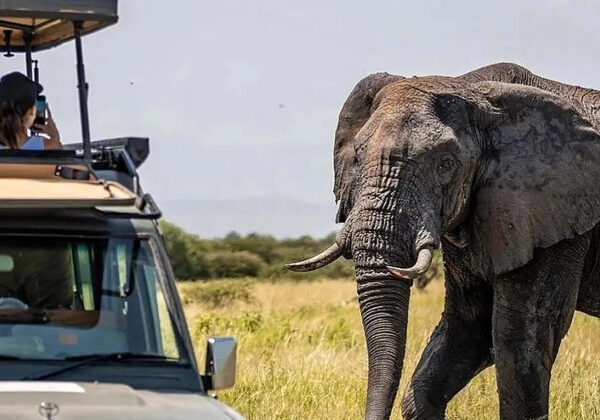
Private Tours in East Africa
Why Private Touring Changes the Experience
The difference isn’t really about luxury. A private tour and a shared group departure can both stay at the same camps and see the same wildlife. What changes is control over timing and pace. A private guide can decide, in real time, to stay an extra twenty minutes at a productive sighting, backtrack for something spotted from the road, or adjust the day’s route entirely based on radio reports from other guides. In a shared vehicle, decisions get made by consensus or by the guide balancing multiple guests’ interests, which naturally means more compromise. For travelers with a specific goal, photography, a particular species, an unhurried pace, that difference in control is significant.
Privacy is the other major factor. A private vehicle means your travel companions are exactly who you chose to bring, nobody else’s schedule or preferences intrude on yours, and conversations with your guide can go as deep as you like into whatever interests you most, without needing to keep pace with a broader group’s attention span.
What “Private” Actually Includes
A dedicated vehicle for your party alone, rather than sharing with other travelers.
A dedicated guide, often with you for the full trip duration rather than changing at each camp, which builds a genuinely valuable rapport and shared understanding of your interests over the days.
Full itinerary flexibility, including the ability to adjust timing, extend stays, or change plans based on real-time conditions.
Private dining options at many camps, where couples or families can request meals served away from the communal dining area if preferred.
Flexible pacing, including later starts, longer stays at sightings, and rest days built in without needing to justify the choice to fellow travelers.
Where Private Touring Is Most Valuable
Photography-Focused Trips
Private touring is close to essential for serious photographers, since positioning, timing, and duration at a sighting all matter enormously for image quality, and a shared vehicle simply can’t accommodate one guest’s photography needs without compromising others’ experience.
Multi-Generational Family Trips
Families spanning grandparents to young children often have very different energy levels and interests throughout a day, and a private vehicle allows the itinerary to flex around naps, shorter attention spans, or a grandparent who needs a slower pace, without needing to negotiate with unrelated travelers in the vehicle.
Milestone Celebrations
Honeymoons, anniversaries, and significant birthdays benefit from the privacy and personalization a private tour affords: private candlelit dinners, surprise experiences arranged with camp staff, and an itinerary built entirely around what the couple or individual actually wants.
Specialist Interest Trips
Birders, walking-safari enthusiasts, or travelers with a specific research or conservation interest benefit enormously from a guide who can dedicate the full day to their particular focus, rather than balancing it against other guests’ general wildlife interests.
Private Tour Structures Available
| Structure | Description | Best For |
| Fully private, single guide throughout | One guide and vehicle for the entire trip, following you between camps where logistics allow | Deepest rapport, most consistent experience |
| Private vehicle, camp-based guides | A private vehicle, but a different specialist guide at each camp | Access to location-specific expertise at each stop |
| Semi-private | A private vehicle for game drives, joining shared group activities for specialty experiences like balloon safaris | Balances privacy with cost efficiency on select activities |
Budget Considerations
Private touring costs more than a shared group departure, and the gap is worth putting in real terms rather than leaving vague. A private guide and vehicle for your own party typically adds somewhere in the range of $150 to $350 a day on top of the base cost of the camps and activities you’d already be paying for. Over a full week, that’s the practical difference between a small-group departure running roughly $2,500 to $6,000 per person and a comparable fully private itinerary running $5,000 to $10,000 or more, depending on the camps and countries involved.
That premium buys a dedicated vehicle and guide rather than shared costs split across a full vehicle of guests. It tends to make the most financial sense on shorter trips, where the value of maximizing every day’s flexibility is highest, or on milestone trips where the experience itself is the priority over minimizing cost.
When to Book
Private touring offers somewhat more scheduling flexibility than joining a fixed group departure, since you’re not tied to another operator’s calendar. That said, the best camps and guides still need to be booked well in advance during peak season, June through October in East Africa, plus the December holidays, so “private” doesn’t mean “last-minute” if you want top-tier properties and highly regarded guides during high-demand periods.
Common Misconceptions About Private Touring
A few misunderstandings come up often enough to address directly. Private touring doesn’t automatically mean five-star luxury accommodation. You can pair a private vehicle and guide with mid-range camps just as easily as with ultra-luxury ones, and the two decisions, vehicle privacy and accommodation tier, are genuinely independent of each other. It also doesn’t mean total isolation from other travelers.
You’ll still cross paths with other guests at communal dining areas in many camps, at popular sightings on shared roads, and during activities like balloon safaris that are inherently group-based regardless of how your ground touring is structured. And it doesn’t guarantee better wildlife sightings than a shared vehicle would get. The animals don’t know or care whether your vehicle is private, though a private guide’s ability to linger or reposition quickly can meaningfully improve your odds at a developing sighting.
Private Touring Across Different Countries
Private touring is available and well-established across every major East Africa destination, though the specifics vary. In Kenya and Tanzania, private vehicles and guides are the default upgrade offered by virtually every operator, with well-developed infrastructure supporting flexible, multi-camp itineraries.
In Uganda and Rwanda, private touring is especially valuable given the more demanding logistics of reaching forest parks and coordinating gorilla or chimpanzee trekking permits around a specific schedule. A private guide who knows the exact road conditions and trekking office procedures removes a lot of friction from what can otherwise be a more complicated logistical picture.
Combining private touring across a multi-country itinerary, Kenya into Tanzania, for instance, typically involves a private guide within each country paired with a private transfer or flight between them, since cross-border guide continuity isn’t usually possible given licensing differences between countries.
How Private Touring Affects Trip Pacing
One of the most underrated benefits of private touring is the ability to genuinely rest when you need to, without feeling like you’re holding up a group or missing out on a scheduled activity. A private itinerary can build in a deliberately unhurried morning after a long travel day, or an entirely unstructured afternoon at camp between game drives, options that are much harder to build into a fixed group schedule where every day tends to be planned to a similar rhythm.
For longer trips of ten days or more, this flexibility in pacing often matters as much as the flexibility in game-drive positioning, since it directly affects how rested and present you feel for the parts of the trip that matter most to you.
How We’d Plan This
The most common question we get from travelers considering private touring is whether it’s “worth it,” and the honest answer depends entirely on what you value. If flexibility, privacy, and a deeply personalized pace matter to you, the investment is usually well justified, and clients rarely regret it.
If you’re equally happy with a well-run shared itinerary and budget is a bigger priority, a scheduled group departure can deliver an outstanding safari at meaningfully lower cost, and we’d tell you that honestly rather than steering you toward the pricier option by default.
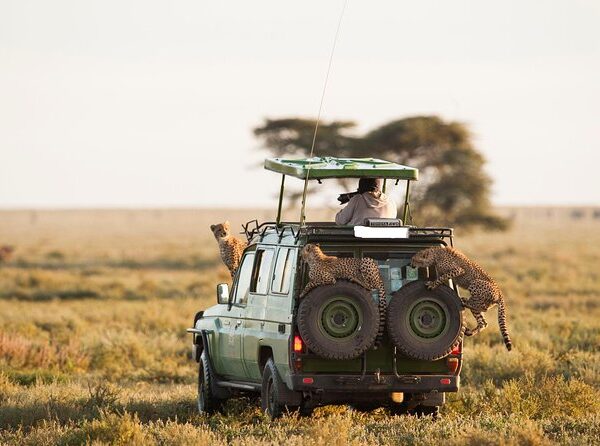
Private Game Drives
For travelers who do choose private touring, we’d recommend requesting the same guide throughout your trip wherever logistics allow, rather than a different guide at each camp. The relationship and shared context that builds over several days genuinely improves the depth of what a guide can offer, from tailored recommendations to a growing understanding of exactly what you find most interesting.
Recommendations by Traveler Type
Photographers: fully private touring with a photography-experienced guide, prioritizing flexible timing at sightings over ground covered.
Multi-generational families: a private vehicle with flexible daily pacing, allowing rest breaks and shorter activity blocks.
Honeymooners and milestone travelers: a fully private itinerary with private dining and personalized touches arranged in advance.
Budget-conscious travelers open to sharing: a well-reviewed scheduled group departure, reserving private touring for a future, more specialized trip.
Frequently Asked Questions
How much more does a private safari cost compared to a group departure?
As a rough guide, a private guide and vehicle typically adds $150 to $350 a day on top of your camp and activity costs, and a full week’s private itinerary often runs $5,000 to $10,000 or more per person, against roughly $2,500 to $6,000 for a comparable small-group departure. We can provide a direct, line-item cost comparison for your specific dates and destinations so you can weigh the trade-off with real numbers.
Can I have the same guide for my entire multi-camp itinerary?
Often yes, particularly within a single country or region, though it depends on logistics and specific camp policies. It’s worth requesting this specifically when we build your itinerary, since it isn’t automatic at every property.
Is private touring necessary for a good safari, or is it just a luxury?
It’s genuinely optional for most travelers. A well-run shared group departure delivers excellent wildlife viewing and a great overall experience. Private touring adds flexibility and privacy, which matter more to some travelers than others, and neither choice compromises on the quality of guiding or access to wildlife itself.
Does private touring make gorilla or chimp trekking easier to arrange?
Somewhat. A private guide handles permit logistics and timing directly, which reduces friction, though the trek itself is still conducted in a group with other travelers assigned to the same gorilla or chimp family, regardless of your overall touring structure.
Let Us Build Your Private Itinerary
Every private itinerary we design starts with an honest conversation about what actually matters most to you on this particular trip, since that’s what determines whether the added investment is genuinely worthwhile. If flexibility, pace, and privacy are what you’re after, we’ll build an itinerary entirely around your interests, with a guide matched to what you care about most. Reach out and let’s start planning.