Volcanoes National Park
Five extinct and dormant volcanoes rise along Rwanda’s northern border, their slopes cloaked in bamboo and montane forest that together form one half of the world’s remaining mountain gorilla habitat. Long before most travellers ever hear the word gorilla, they encounter a photograph of this landscape, dark volcanic cones wrapped in cloud, and it is worth understanding the mountains themselves before diving into permits and logistics, since the terrain shapes nearly everything about how a visit here actually unfolds.
We find it useful to introduce Volcanoes National Park through its geography first, because the park’s defining feature, five volcanoes forming a single connected massif with Uganda and the Democratic Republic of Congo, explains both why the gorillas are here and why Rwanda’s trekking experience feels so different from a savannah safari. This is not a park you drive through scanning for animals on an open plain; it is a mountain range you enter on foot, and that changes the nature of everything from packing to pacing to expectation.
The Virunga Massif and Its Five Peaks
Volcanoes National Park protects the Rwandan slopes of five of the eight Virunga volcanoes, Karisimbi, Bisoke, Sabyinyo, Gahinga, and Muhabura, together forming a single, internationally shared conservation landscape: Karisimbi, at 4,507 metres, is Rwanda’s highest point, its upper slopes occasionally dusted with frost given the altitude.
Bisoke holds a striking crater lake at its summit, reachable via a moderate full-day hike. Sabyinyo’s jagged, eroded peak marks a point where Rwanda, Uganda, and the Democratic Republic of Congo meet, though the more famous tripoint hike is typically done from the Ugandan side at Mgahinga.
This shared, cross-border massif is precisely why gorilla family movement across national boundaries is a genuine phenomenon here, the same reason Uganda’s Mgahinga sees intermittent gorilla trekking availability. Rwanda’s side of the range holds the larger, more consistently accessible population, spread across bamboo forest and montane vegetation zones that shift with altitude from agricultural foothills to Afro-alpine moorland near the highest summits.
The Gorillas: Population, Families, and Daily Life
Roughly a third of the world’s remaining mountain gorillas live within the Virunga Massif, and Volcanoes National Park’s share is organised into twelve habituated families open to tourism, with eight permits allocated per family each day, giving a standard daily capacity of 96 trekking permits.
A number of additional groups are habituated primarily for ongoing research rather than tourism, and on the rare occasion that a tourist-designated family crosses overnight into Uganda or the Democratic Republic of Congo, one of these research groups can be substituted for the day’s trekking allocation.
Each family has its own personality and history, tracked daily by dedicated teams who know individual gorillas by sight and behaviour. Some families range across gentler, more open bamboo slopes; others favour steeper, denser terrain higher up the mountain.
Rangers assign trekkers to families each morning at Kinigi headquarters, generally weighing a group’s fitness against a family’s typical territory, though the day’s actual walk depends entirely on where that specific family happens to be.
The Rwanda Development Board does not accept advance requests for specific families under the standard permit system, though a private trekking experience, allowing exclusive access to a single family with a dedicated guide, is available at a considerably higher price for travellers who want that level of control.
A Living Research Legacy
Karisoke Research Center, established by primatologist Dian Fossey in 1967 on the saddle between Bisoke and Karisimbi, remains an active research station today, continuing over five decades of continuous gorilla monitoring, among the longest-running wildlife studies anywhere in the world.
A guided half-day hike to Fossey’s former camp and grave site, where she is buried alongside several of the gorillas she studied, offers a genuinely different kind of visit than the trekking itself, more reflective, historically grounded, and considerably less physically demanding.
Gorilla Trekking Safari Experience
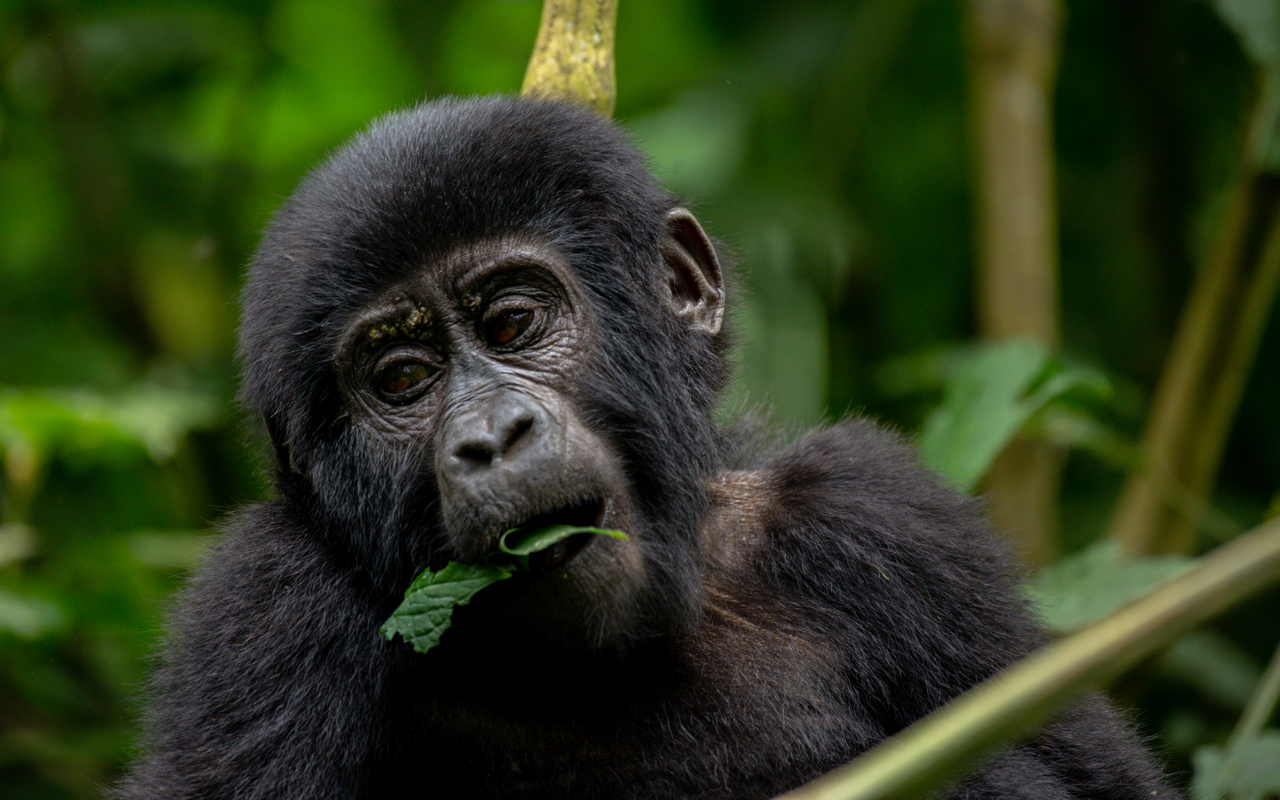
Each September, Kwita Izina, Rwanda’s public gorilla naming ceremony, draws conservationists and visitors to Kinigi to name that year’s infant gorillas, a modern tradition modelled loosely on Rwandan baby-naming customs and one of the more visible ways the country has turned gorilla conservation into a source of national pride rather than simply a tourism product.
Beyond Gorillas: Golden Monkeys and Volcano Hikes
Golden Monkey Trekking
In the park’s lower bamboo zones, large troops of golden monkeys, an endangered species found only in the Virunga region and at Gishwati-Mukura, offer a shorter, less expensive, and highly reliable primate encounter. At around 100 US dollars per person against the gorilla permit’s 1,500, and requiring only two to three hours, this activity rounds out a Volcanoes National Park stay for a fraction of the cost and effort.
Climbing Bisoke and Karisimbi
Mount Bisoke’s crater lake summit is reachable in a demanding but achievable single day, a genuine reward for moderately fit hikers. Mount Karisimbi, by contrast, is a two-day expedition with an overnight camp partway up the mountain, considerably more physically serious and better suited to experienced trekkers specifically seeking that challenge rather than a casual add-on.
The Cultural Landscape Around the Park
Iby’Iwacu Cultural Village, near Kinigi, was founded in part by former poachers who once hunted in these same forests and have since moved into conservation and tourism work. A half-day visit here, dance performances, a recreated traditional royal hut, banana beer brewing, pairs naturally with a trekking day and adds a human dimension to a trip otherwise focused entirely on wildlife. The nearby Gorilla Guardians Village offers a similar programme on a smaller scale, and either makes a worthwhile afternoon addition.
Rules Every Trekker Should Know
| Rule | Reasoning |
| Minimum 7-metre distance from gorillas | Reduces disease transmission risk given genetic closeness to humans |
| No flash photography | Avoids startling or distressing the gorillas |
| Maximum 1 hour once located | Limits cumulative daily human contact per family |
| Minimum age of 15 | Enforced consistently with no exceptions, in line with IUCN best practice guidelines applied across Rwanda, Uganda and the DRC |
Planning a Visit: Permits, Timing, and Cost
| Item | Approx. Cost | Notes |
| Standard gorilla trekking permit | US$1,500 per person | Fixed year-round outside the low-season discount |
| Low-season discounted permit | US$1,050 per person | November – May, requires 2+ nights at both Akagera and Nyungwe |
| Golden monkey trekking permit | ~US$100 per person | Separate from the gorilla permit |
| Mount Bisoke hike | US$75 – 100 per person | Full-day, moderate difficulty |
| Mount Karisimbi expedition | US$400 – 500 per person | Two-day, considerably more demanding |
| Private gorilla trekking experience | US$15,000 for exclusive access to one family | Premium option with a dedicated guide, booked well ahead |
The park sits roughly two and a half to three hours from Kigali by road, among the shortest airport-to-trekking transfers of any major gorilla destination in the region, which is part of why Rwanda’s overall gorilla trekking system has such a reputation for logistical efficiency.
Permits should be booked three to six months ahead for standard travel, and closer to nine to twelve months out for June to September or December to February dates specifically, when demand is consistently at its highest and permits for the most popular weeks can sell out well in advance.
Where to Stay
One&Only Gorilla’s Nest, positioned closest to Kinigi park entrance, prized for minimising morning transfer time.
Bisate Lodge, with architecturally distinctive cocoon-shaped villas built into the volcanic foothills.
Virunga Lodge, roughly an hour from the park entrance, offering sweeping views over the volcanoes and nearby twin lakes.
Mountain Gorilla View Lodge, a comfortable mid-range option roughly twenty minutes from the trailhead.
Hotel Muhabura in Musanze town, a well-established budget-to-mid-range choice.
When to Go
| Season | Months | What to Expect |
| Long Dry Season | June – September | Firmer trails, peak demand, book six to twelve months ahead |
| Short Dry Spell | December – February | Similarly strong conditions, slightly less crowded |
| Wetter Months | March – May, October – November | Muddier trails, lower prices, the low-season discount window (Nov-May) |
How This Compares to Trekking in Uganda
Travellers weighing Rwanda against Uganda’s Bwindi Impenetrable National Park should understand the trade-off plainly: Rwanda’s permit costs 1,500 US dollars against Uganda’s 800, but the transfer from Kigali runs two and a half to three hours compared to Bwindi’s eight to nine hours by road.
Rwanda’s single, centralised trekking area also means less terrain variety than Bwindi’s four distinct sectors, and considerably fewer habituated families overall, roughly twelve compared with Bwindi’s twenty-plus, meaning Uganda’s system carries more daily permit capacity and, in practice, somewhat more last-minute availability.
This is a genuine trade of choice and terrain variety for cost and convenience that suits different travellers differently, and increasingly, some travellers choose to combine both destinations in a single cross-border itinerary given how straightforward the Rwanda-Uganda land crossing has become.
Activities to Do in the Park
Gorilla Trekking
Gorilla trekking remains the park’s central activity and the reason most travellers arrive in the first place. Each morning, trekkers gather at Kinigi headquarters for a briefing before rangers assign them to one of twelve habituated families based on group fitness. The walk itself can run anywhere from two to seven hours depending on where the assigned family has moved since it was last located, followed by a strictly enforced one-hour viewing window once the group is found.
Golden Monkey Trekking
Golden monkey trekking offers a shorter, more reliable, and considerably less expensive complement to gorilla trekking. Troops in the park’s bamboo zones can number over a hundred individuals, and the two to three hour trek rewards visitors with a far more active, visually dynamic encounter than the calmer gorilla family scene, given how much time golden monkeys spend leaping between bamboo stalks.
Hiking Mount Bisoke
Hiking Mount Bisoke takes most of a day and rewards a moderate level of fitness with a genuinely striking crater lake at the summit. The trail climbs through changing vegetation zones as altitude increases, and clear-day views extend across the surrounding volcanic landscape and neighbouring Lake Ngezi and Lake Bulera.
Climbing Mount Karisimbi
Climbing Mount Karisimbi is a considerably more serious undertaking, a two-day expedition with an overnight camp partway up the mountain before a final push to Rwanda’s highest point at 4,507 metres. This is best reserved for experienced, well-prepared hikers rather than treated as a casual add-on to a gorilla trekking stay.
Visiting the Dian Fossey Site
Visiting Dian Fossey’s former research camp and grave site at Karisoke is a half-day hike considerably gentler than any of the above, offering a reflective, historically grounded alternative activity for a rest day between more physically demanding treks. Fossey is buried alongside several of the gorillas she studied, on the saddle between Bisoke and Karisimbi.
Cultural Village Visits
A cultural village visit, whether to Iby’Iwacu or the smaller Gorilla Guardians Village, rounds out a stay with traditional dance performances, a recreated royal hut, and craft demonstrations, often led by former poachers now working in conservation and tourism. This half-day activity pairs naturally with an afternoon following a morning trek.
Birdwatching
Birding within the park’s bamboo and Afro-alpine zones rewards patient visitors with a range of high-altitude specialists distinct from the lower-elevation species found at Nyungwe, though this is generally pursued as a secondary activity alongside primate trekking rather than a dedicated pursuit given the park’s trekking-focused infrastructure.
Frequently Asked Questions
How many volcanoes make up the park?
Five: Karisimbi, Bisoke, Sabyinyo, Gahinga, and Muhabura, the Rwandan portion of the eight-volcano Virunga Massif shared with Uganda and the Democratic Republic of Congo.
Can I visit Dian Fossey’s grave?
Yes, via a guided half-day hike to the former Karisoke Research Center site on the saddle between Bisoke and Karisimbi, where she is buried alongside several gorillas she studied.
Is Bisoke or Karisimbi the better hike for most visitors?
Bisoke, a demanding but achievable single-day hike to a crater lake summit, suits most moderately fit travellers. Karisimbi’s two-day expedition is considerably more serious and better reserved for experienced hikers specifically seeking that challenge.
How many gorilla permits are available each day?
Standard capacity is 96 permits daily, eight per family across twelve tourist-accessible habituated families, though some sources cite a higher figure following recent adjustments, so it’s worth confirming current capacity with your operator when booking.
What is Kwita Izina?
Rwanda’s annual gorilla naming ceremony, held each September near Kinigi, celebrating that year’s infant gorillas and drawing conservationists and visitors from around the world.
Is golden monkey trekking worth adding to a gorilla trekking trip?
Yes, given its low cost, high reliability, and considerably shorter time commitment, it is one of the easiest, most worthwhile additions to a Volcanoes National Park stay.
Can I request a specific gorilla family?
Not under the standard permit system; assignments are made each morning based on fitness and current tracker reports. A private trekking experience offering exclusive access to a chosen family is available at a considerably higher price for travellers who want that level of control.