Lake Nakuru National Park
Lake Nakuru National Park sits in the floor of the Great Rift Valley in Nakuru County, about 157 kilometers roughly three hours by road — northwest of Nairobi, immediately south of Nakuru town. The park covers around 188 square kilometres, small enough to explore thoroughly in a single full day.
Nakuru town itself, immediately north of the park, is Kenya’s fourth-largest city and a genuine working urban centre rather than a purpose-built safari gateway, which gives a Nakuru visit a slightly different texture from parks reached via smaller, more tourism-oriented towns. Travellers passing straight through often don’t notice this, but it’s worth knowing if you’re planning a longer stopover with time to explore beyond the park gates.
Overview
Lake Nakuru National Park encircles a shallow soda lake in the floor of the Great Rift Valley. It’s compact by Kenyan standards, which makes it an efficient park to visit on a shorter itinerary, and it packs a genuinely varied landscape into that small footprint: open lakeshore, acacia woodland, rocky escarpment and patches of dense euphorbia forest.
The park is best known for two things that don’t always coincide elsewhere: extraordinary flamingo numbers and a well-established rhino sanctuary. Since being fenced and declared a sanctuary in 1987, Lake Nakuru has become one of the more dependable places in Kenya to see both black and white rhino on the same game drive, which sets it apart from parks where rhino sightings are rare and largely down to luck.
The lake itself has been through significant ecological change over the past decade and a half, rising well beyond its historic shoreline and altering both the birdlife it attracts and the roads and infrastructure around it. This isn’t a reason to avoid Nakuru, since the park’s core wildlife draws remain as strong as ever, but it does mean returning visitors should expect a genuinely different lakeshore from what older guidebooks or photographs might suggest.
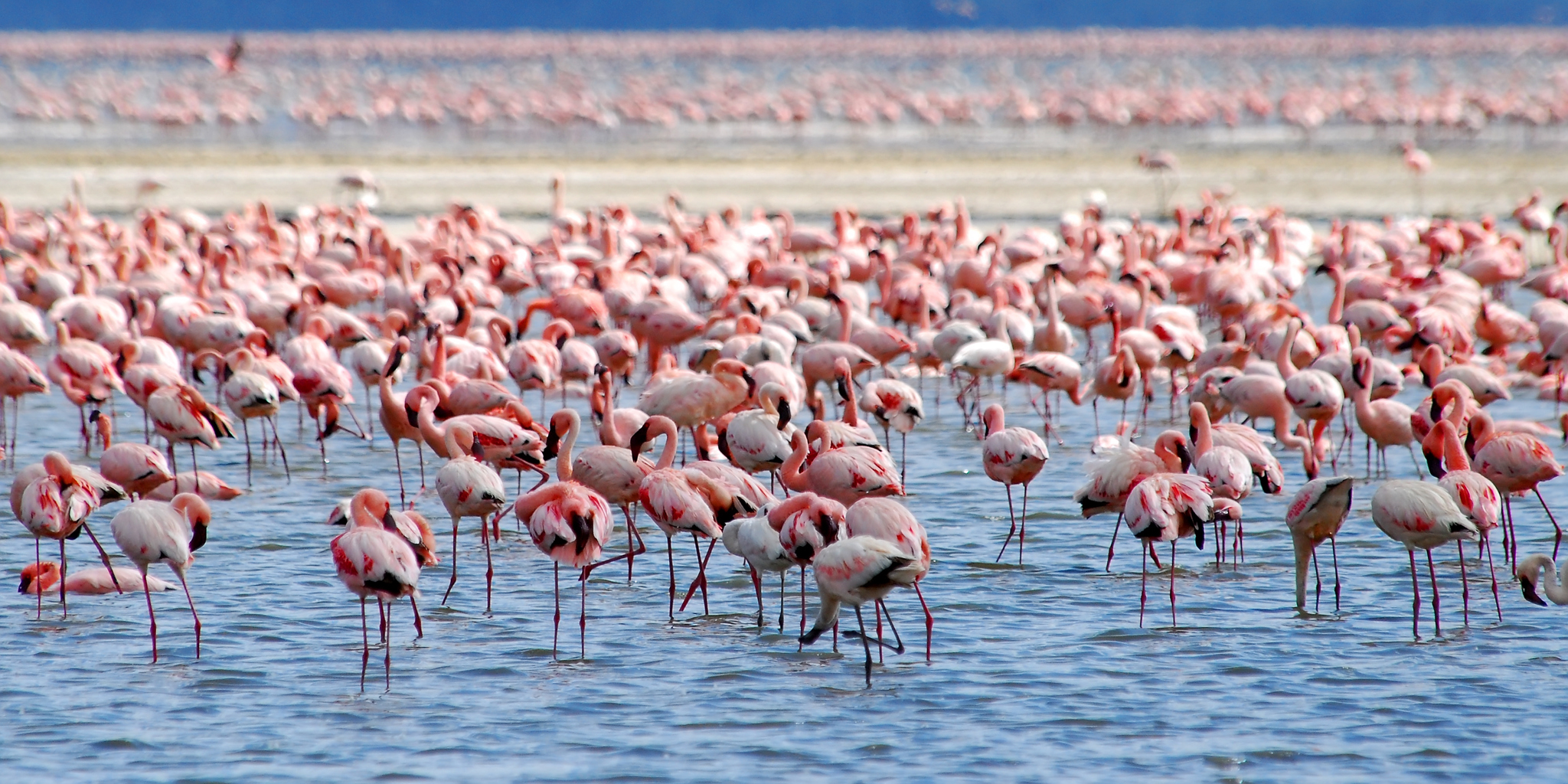
Flamingos in Lake Nakuru National Park
Best Time to Visit
The dry seasons — June to October and January to March — are best for game viewing, as shrinking water sources elsewhere push wildlife toward the lake. Flamingo numbers fluctuate independently of season, driven more by the lake’s algae levels and water chemistry in a given year, so it’s worth asking your lodge or guide about current conditions rather than planning purely around the dry-season calendar.
Lake Nakuru is a Kenya Wildlife Service park with a flat, year-round entry fee of approximately 90 US dollars per non-resident adult, placing it in the same premium tier as Amboseli rather than the lower-fee bracket that covers parks like Tsavo and Nairobi National Park.
Getting There and Where to Stay
Getting There
Most visitors drive from Nairobi, a straightforward two-and-a-half to three-hour trip on the Nairobi–Nakuru highway. Flying is also an option — the hop from Jomo Kenyatta International Airport to the park’s Naishi airstrip takes only about 25 minutes — though given the short drive time, road transfer is by far the more common choice for this park. Guides note that the main gate near Nakuru town can suffer from unreliable mobile signal for the cashless payment system KWS now requires, and several recommend using the Lanet Gate instead, which offers steadier connectivity and leads directly into the rhino-rich southern sector.
Where to Stay
Several lodges sit directly inside the park, including Sarova Lion Hill Lodge and Lake Nakuru Lodge, both offering the convenience of waking up already inside the reserve. Self-catering and camping options — Naishi Guest House and several public campsites — suit budget travellers or those touring by self-drive vehicle, while a handful of comfortable hotels near the park entrance serve as an alternative base.
Given the lake’s rising water levels in recent years, it’s worth confirming with any in-park lodge whether their specific access road remains unaffected, since some routes that once ran close to the shoreline have needed rerouting further inland, and older reviews or maps may not reflect the current layout.
Activities
Nakuru’s small size means activities are concentrated and easy to combine into a single day or overnight stay, though the park rewards travellers who resist the temptation to rush through it in a single rapid loop.
Game Drives
Morning and afternoon drives in a 4×4 with an experienced guide cover the lake shore, the escarpment roads and the wooded areas where rhino tend to browse. Because the park is compact, a full day here typically covers considerably more ground, proportionally, than a similar day in a larger park like the Mara or Tsavo.
Photography Safaris
The combination of flamingo-lined shoreline, dramatic escarpment backdrops and reliable rhino sightings makes Nakuru a favourite stop for photographers, and several operators run drives specifically timed around the best light — early morning for the lake and mist, late afternoon for warm light on the escarpment.
Guided Nature Walks
Some lodges and camps around the park’s boundary offer short guided walks focused on birdlife and smaller wildlife that a vehicle would pass by — this isn’t available throughout the park itself, so check with your accommodation about where walks are permitted.
Birdwatching
With over 400 recorded species, Nakuru rewards even a casual interest in birds. Flamingos and pelicans dominate the shoreline, while African fish eagles patrol overhead and a wide range of smaller species inhabit the woodland and escarpment areas — worth allowing extra time if birding is a genuine priority rather than an afterthought.
Escarpment Drives
Beyond the lakeshore circuit, the park’s rocky escarpment roads offer a genuinely different game-viewing experience, winding through wooded terrain where klipspringer and buffalo are more commonly encountered than on the open plains below, along with some of the park’s best late-afternoon photographic light.
Picnicking by the Lake
Several designated picnic sites along the shoreline let visitors get out of the vehicle for a proper break, generally under the supervision of park rangers given the presence of buffalo and occasionally rhino in the surrounding area, and they offer a genuinely pleasant way to slow down a full day’s circuit rather than treating the park purely as a drive-through.
Attractions
A handful of specific sights make Nakuru worth the detour from a Nairobi-based itinerary.
The Flamingo Flocks
Nakuru has historically hosted some of the largest flamingo gatherings on earth — up to two million greater and lesser flamingos feeding on the lake’s algae in good years, turning the shoreline pink from a distance. Numbers fluctuate with water levels and algae conditions year to year, so ask your guide or lodge about current conditions before you go, since the lake’s chemistry shifts periodically and flamingos move to other Rift Valley lakes when it does.
The Rhino Sanctuary
Since its 1987 designation, the park has become a genuine conservation success story, with both black and white rhino populations growing steadily under protection. Sightings here are meaningfully more likely than in most other Kenyan parks, which makes Nakuru a strong choice for travellers who specifically want a good chance at completing the Big Five.
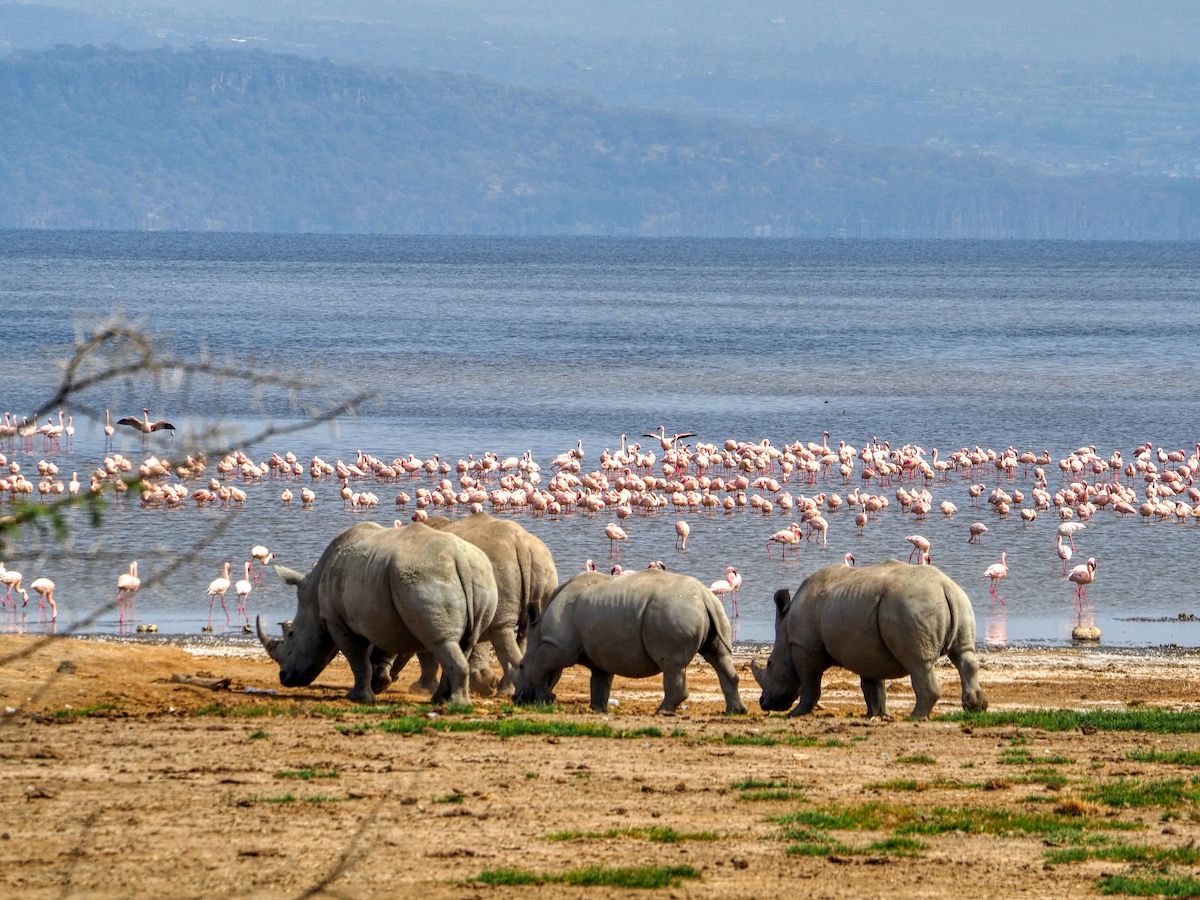
Rhinos in Lake Nakuru National Park.
Baboon Cliff
This viewpoint delivers a sweeping panorama over the flamingo-fringed lake and the valley floor below, and it’s a natural stop to break up a game drive — allow enough time to actually get out, take in the view and get a sense of the park’s scale rather than just passing through.
Makalia Falls
Tucked into a wooded valley in the park’s southern section, these falls are a quieter, more scenic stop than most of the park’s open-plains scenery, and a good spot for a picnic stop if your schedule allows a longer visit rather than a rushed half-day.
The Euphorbia Forest
Dense stands of candelabra euphorbia trees along parts of the park give Nakuru a genuinely different visual character from the acacia savannah found elsewhere in Kenya, and they’re worth noting as you drive through — this habitat also supports different bird and primate life than the open shoreline.
Out of Africa Viewpoint
A well-known lookout point along the park’s escarpment, this spot takes its name from the 1985 film and offers one of the more photographed panoramas of the lake and valley floor, best visited in the softer light of late afternoon.
Wildlife Highlights
Black and White Rhino
As one of Kenya’s flagship rhino sanctuaries since 1987, Nakuru offers a genuinely strong chance of seeing both species on a single drive, a rarity almost anywhere else in the country.
Rothschild’s Giraffe
Introduced to the park as part of a conservation programme, this endangered giraffe subspecies — pale-legged and distinct from the Maasai giraffe further south — now thrives within the park’s boundaries.
Flamingo Flocks
When conditions align, greater and lesser flamingos gather in numbers that can run into the hundreds of thousands, feeding on the lake’s algae and turning long stretches of shoreline pink.
Lion and Leopard
Beyond its rhino and flamingo reputation, Nakuru holds a resident lion population and a more elusive leopard presence in the escarpment woodland, giving the park a genuine predator dimension that’s easy to overlook amid its more famous draws.
Fun Facts
- Lake Nakuru’s water levels have risen dramatically since the early 2010s, submerging former shoreline roads and prompting several lodges to adjust their access routes.
- The park was among the first in Africa to be completely fenced, a measure introduced specifically to protect its growing rhino population from poaching.
- Flamingos get their pink colour from pigments in the algae and small crustaceans they feed on, not from any pigment of their own.
- Nakuru’s candelabra euphorbia forest is one of very few of its kind protected within a national park anywhere in East Africa.
- The park was originally gazetted in 1961 as a bird sanctuary specifically to protect its flamingo population, before being expanded and redesignated a full national park in 1968.
- Nakuru’s rising water levels are part of a wider phenomenon affecting several Rift Valley lakes simultaneously, including Naivasha and Baringo, a trend researchers still don’t fully understand.