
Flying Safaris in Uganda
Flying safaris in Uganda offer an extraordinary experience. Uganda’s national parks and gorilla forests are blessed with extraordinary wildlife and scenery, but they also share one practical challenge for travelers with limited time: they are often separated by long, sometimes grueling road journeys of six, eight, or even ten hours across winding, mountainous country roads.
Fortunately, an increasingly well-developed network of small aircraft and remote bush airstrips now makes it possible to leapfrog these long drives entirely, connecting Entebbe International Airport and Uganda’s major safari destinations with scenic flights of little more than an hour, transforming the logistics of a Ugandan safari and opening up remote, otherwise time-consuming destinations to travelers with tighter schedules.
A flying safari in Uganda offers considerably more than mere convenience, delivering spectacular aerial views over Lake Victoria, the dramatic Albertine Rift escarpment, the Victoria Nile floodplain, and the dense, cloud-wreathed canopy of Bwindi Impenetrable Forest, views utterly inaccessible to travelers confined to the ground.
For gorilla trekkers in particular, arriving fresh and well rested after a short scenic flight, rather than exhausted after a nine or ten hour drive, makes a genuine difference to enjoying one of Africa’s most physically demanding wildlife experiences the following morning.
This guide explains everything you need to know about flying safaris in Uganda, covering the country’s main domestic airlines and airstrips, typical flight times and costs, which destinations particularly benefit from flying rather than driving, and how to plan and combine a flying safari itinerary.
Whether you are considering a single flight to save time on a specific leg of your journey or a fully aerial, multi-park Ugandan adventure, here is a complete guide to exploring the Pearl of Africa from above.
Uganda’s Domestic Flying Safari Airlines
Two main domestic carriers operate scheduled and chartered flights connecting Entebbe International Airport with Uganda’s principal national parks, using small, sturdy Cessna Grand Caravan aircraft well suited to the short grass and gravel airstrips found within or near the country’s remote wilderness areas. Aerolink Uganda, the country’s most established and widely used flying safari operator, runs daily scheduled flights from its Entebbe base to airstrips serving every major park, while Fly Uganda operates a similar scheduled and charter service from its private airfield at Kajjansi, near Kampala, with options to arrange onward transfers to Entebbe.
Both airlines also offer chartered flights for private groups or for routes not covered by the scheduled network, allowing travelers to fly directly between two parks, such as from Bwindi to Murchison Falls, without routing back through Entebbe on the scheduled service.
A third operator, BAR Aviation Uganda, provides additional scheduled and charter capacity to several of the same destinations, giving travelers a useful degree of choice and flexibility, particularly for last-minute bookings or unusual routing requirements.
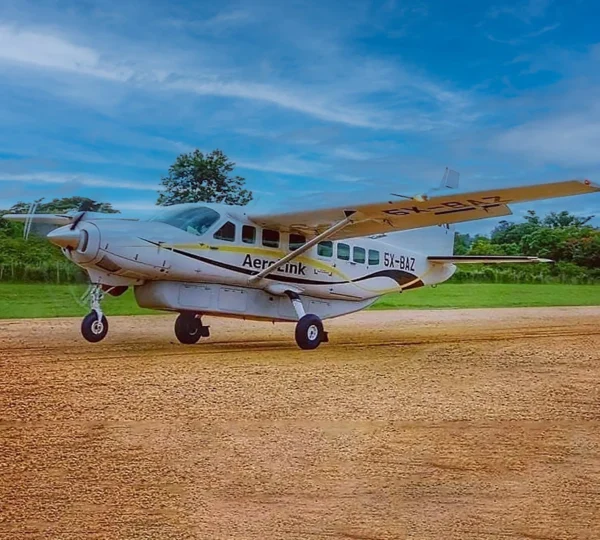
Flying Safaris in Uganda to see Gorillas
Key Airstrips and the Parks They Serve
Understanding which airstrip serves which national park, and in some cases which specific sector within a park, is essential for booking the right flight and coordinating your ground transfer to your lodge, since several parks are served by more than one airstrip depending on which part of the park your accommodation and activities are located in.
| Airstrip | Serves |
| Kihihi | Northern Bwindi (Buhoma, Ruhija) and Ishasha sector of Queen Elizabeth |
| Kisoro | Southern Bwindi (Nkuringo, Rushaga) and Mgahinga Gorilla National Park |
| Kasese and Mweya | Queen Elizabeth National Park and Kibale Forest National Park |
| Pakuba | Northern Murchison Falls National Park (Paraa) |
| Bugungu | Southern Murchison Falls National Park |
| Chobe | Eastern Murchison Falls National Park |
| Apoka | Kidepo Valley National Park |
| Semliki | Semuliki National Park and Wildlife Reserve |
| Mbarara | Lake Mburo National Park and Lake Bunyonyi |
Because Bwindi’s four trekking sectors are spread across a considerable area, choosing the correct airstrip for your specific gorilla permit sector matters just as much when flying as when driving, so always confirm with your operator that your flight destination matches your assigned trekking sector before booking.
Flight Times and What to Expect
Scheduled flights from Entebbe to Uganda’s national park airstrips typically take between one hour and one hour forty-five minutes, a remarkable contrast to the corresponding road journeys, several of which stretch to eight, nine, or even ten hours of driving over Uganda’s often congested and, in more remote areas, poorly surfaced roads. This dramatic time saving is the single greatest practical advantage of flying, freeing up an entire additional day or more for wildlife viewing, gorilla trekking, or simply resting rather than sitting in a vehicle.
Flights are typically operated using Cessna Grand Caravan aircraft, sturdy single-engine planes seating around twelve to fourteen passengers, often featuring clear glass cockpits that allow passengers a genuine sense of flying alongside the pilots, adding a further element of adventure and enjoyment to the journey.
The aerial views along the way are frequently spectacular in their own right, with the route to Bwindi’s airstrips passing over Uganda’s dramatic, terraced southwestern highlands, often compared to the rugged beauty of Nepal, while flights to Murchison Falls cross Lake Victoria, the Albertine Rift escarpment, and the sweeping floodplain of the Victoria Nile.
Cost of Flying Safaris in Uganda
The cost of domestic flights in Uganda varies according to the specific route, the season, and whether you book a scheduled seat or a private charter, and understanding this pricing helps in budgeting realistically for a flying safari itinerary. Scheduled one-way flights from Entebbe to most national park airstrips typically cost in the region of USD 150 to 250 per person, though prices fluctuate with demand and advance booking, with earlier booking generally securing better availability and pricing.
Chartered flights, booked privately for a specific group rather than as individual seats on a scheduled service, cost considerably more overall but offer complete flexibility over timing and routing, including the ability to fly directly between two parks without transiting through Entebbe. For larger groups of four or more travellers, the total cost of chartering a flight can become comparable to the combined cost of scheduled seats once the value of time saved and routing flexibility is factored in, making charter flights a genuinely worthwhile consideration for families or groups travelling together on a flexible, tailor-made itinerary.
Why Fly to Bwindi for Gorilla Trekking
Among all of Uganda’s flying safari routes, the flight to Bwindi Impenetrable Forest arguably offers the single greatest practical benefit, given that the alternative road journey from Entebbe stretches to a demanding eight to ten hours across steep, winding mountain roads. Arriving exhausted after such a long drive is a genuinely poor way to prepare for a physically demanding gorilla trek scheduled for early the following morning, and many experienced operators now actively recommend flying specifically for this reason.
Choosing between Kihihi and Kisoro airstrips depends entirely on which Bwindi sector your gorilla permit covers, with Kihihi serving the northern Buhoma and Ruhija sectors, roughly a two-hour onward drive from the airstrip, and Kisoro serving the southern Nkuringo and Rushaga sectors, similarly around a two-hour drive away. Flying into the correct airstrip for your sector, arriving relaxed and refreshed rather than travel-weary, allows you to settle into your lodge, enjoy an evening at leisure, and wake genuinely rested and ready for what can be a strenuous day on the trail.
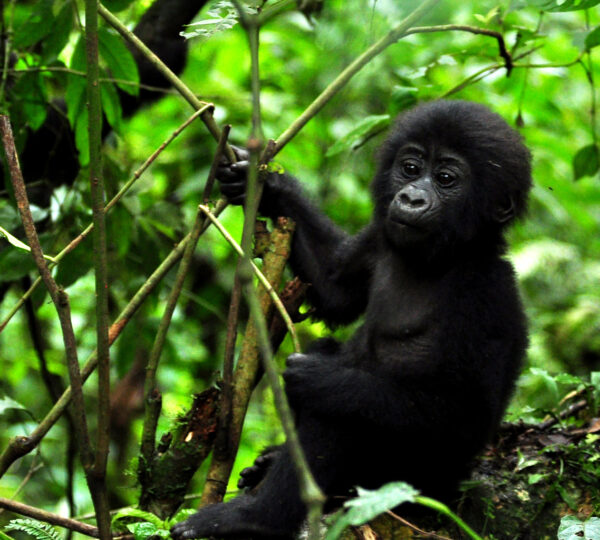
Baby Gorilla
Flying to Uganda’s Other Remote Parks
Beyond Bwindi, several of Uganda’s other outstanding parks benefit enormously from flying access, particularly those in the country’s more remote corners where road journeys can otherwise consume the majority of a shorter safari itinerary. Kidepo Valley National Park, Uganda’s remote, wildly beautiful northeastern gem, exemplifies this benefit perhaps more than any other Ugandan destination, since the road journey from Kampala stretches to ten to twelve grueling hours each way, making a short visit to this exceptional but historically overlooked park essentially impractical for travelers without extensive time to spare.
A scheduled or chartered flight to Kidepo’s Apoka airstrip transforms this calculation entirely, turning what would otherwise be a multi-day expedition purely to reach the park into a straightforward extension of a wider Ugandan itinerary, typically taking around ninety minutes from Entebbe or a short onward hop from Murchison Falls. This accessibility has been transformative for Kidepo’s growing recognition as one of Uganda’s most rewarding, uncrowded wildlife destinations, opening this remote wilderness to travelers who would otherwise never have had the time to include it in their itinerary.
Combining Flights Into a Multi-Park Itinerary
One of the great strengths of Uganda’s flying safari network is the ease with which multiple parks can be woven together into a single, efficient, multi-destination itinerary, hopping by air from one wilderness area to the next without the cumulative burden of multiple long road transfers eating into precious safari time. A well-designed flying itinerary might combine gorilla trekking in Bwindi, reached via Kihihi or Kisoro, with game drives and a boat cruise in Queen Elizabeth National Park via Kasese or Mweya, before continuing to Murchison Falls via Pakuba, Bugungu, or Chobe, and even extending to the remote wilderness of Kidepo Valley, all within a single, streamlined, largely aerial journey.
This kind of comprehensive flying safari particularly suits travelers with generous budgets but limited time, allowing an extraordinarily rich, multi-park Ugandan adventure to be compressed into a week to ten days that would otherwise require considerably longer if traveling primarily by road. Some itineraries extend even further, connecting Uganda’s flying network with onward flights to Kenya’s Maasai Mara or Tanzania’s Serengeti, allowing a truly comprehensive East African flying safari spanning gorillas, chimpanzees, and the Great Migration within a single, efficiently planned journey.
Flying Versus Driving:
Deciding whether to fly or drive between Uganda’s destinations ultimately depends on a balance of three key factors: your available time, your budget, and how much you value the road journey itself as part of the overall safari experience, and different travelers will reasonably reach different conclusions based on their own priorities.
- Choose flying if time is limited: flying frees up additional days for wildlife viewing and gorilla trekking rather than sitting in transit.
- Choose flying to avoid fatigue before physically demanding activities: arriving rested rather than exhausted considerably improves the gorilla trekking experience, specifically.
- Choose flying for remote destinations: parks such as Kidepo Valley become genuinely practical additions to an itinerary only when accessed by air.
- Choose driving if budget is the primary concern: road transport remains considerably more affordable, particularly for larger groups sharing a vehicle.
- Choose driving if you value the journey itself: Uganda’s countryside, villages, and roadside life offer their own rewarding, immersive experience that flying bypasses entirely.
- Consider a mixed approach: many travelers fly for the longest, most grueling legs, such as to Bwindi or Kidepo, while driving shorter, more scenic, and manageable sections of their itinerary.