
Ultimate Guide to Guided Walking Safaris in East Africa
Guide to Guided Walking Safaris in East Africa; There’s a specific moment on a walking safari that a vehicle-based game drive simply can’t replicate: crouching beside a fresh lion track while an armed guide quietly explains how many hours old it is, how fast the animal was moving, and which direction it was heading.
You’re no longer viewing wildlife from behind glass and metal. You’re reading the same landscape the animals do, at the pace their world actually moves, and that changes how the whole experience feels, often within the first ten minutes.
Guided walking safaris aren’t a replacement for game drives. They’re a different register entirely, trading a vehicle’s range and speed for intimacy, sensory detail, and a level of engagement with the bush that’s genuinely hard to describe until you’ve done it. This guide covers where it’s available, what to expect, and who it actually suits.
Should You Add Walking to Your Safari?
If you’ve been on a vehicle safari before and want a deeper, slower experience, or if you’re drawn to tracking, ecology, and the small details of the bush, insect life, plant use, animal signs, walking is very likely to become a highlight of your trip.
If mobility is a concern, or your primary goal is maximizing the number and variety of large mammal sightings across a limited number of days, a vehicle-based safari will deliver more volume, and walking should be an addition rather than a replacement.
Most of our clients do both, treating walking as a two-to-three-hour morning activity layered into a broader vehicle-based itinerary rather than building an entire trip around it. That combination tends to be the most satisfying structure for a first-time walking safari guest.
A Chief, a Game Ranger, and the Birth of the Modern Bush Walk
It’s worth knowing where this activity actually comes from, because the origin story shapes the ethics still governing it today. In 1950, a young game ranger named Norman Carr persuaded Senior Chief Nsefu of the Kunda people to set aside a stretch of tribal land in Zambia’s Luangwa Valley as a game reserve, and built the country’s first camp open to the public specifically for viewing wildlife rather than shooting it. Revenue from the camp flowed straight back to the chief and his community, a model of conservation-through-tourism that predated formal community-based natural resource management principles by nearly half a century.
Carr’s real innovation, though, was putting guests on their feet. He believed the only way to build a genuine appreciation for the bush was to experience it without a vehicle between you and it, tracking, listening, and moving at the pace the animals themselves set.
That idea, radical for its time, is why South Luangwa National Park is still widely referred to as the home of the walking safari, and why the training standards Carr established there remain the benchmark the rest of the industry measures itself against.
Why Walking Safaris Offer Something a Vehicle Can’t
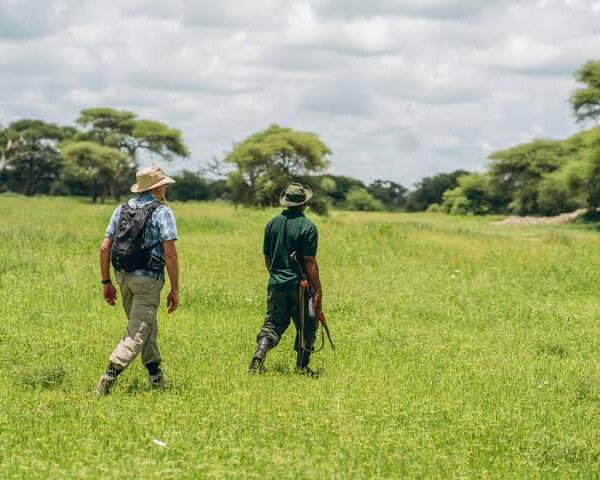
A vehicle covers ground fast and gets you close to big, obvious wildlife, but it also insulates you from the bush. You observe from within a machine, at a remove, and the smaller details of the ecosystem largely pass by unnoticed. On foot, guides shift the entire focus. You’ll stop to examine termite mounds and what they reveal about the surrounding soil chemistry, learn to identify a dozen different antelope species by track alone, and understand the medicinal or practical uses of plants local communities have relied on for generations.
Guided Walking Safaris in East Africa
Predator encounters, when they happen, are approached with far more caution and distance than a vehicle would ever need, which paradoxically makes them feel more significant. You’re keenly aware you’re a guest in the animal’s space rather than an observer protected by a vehicle’s presence.
Guides leading walks are held to a different, considerably higher standard of certification than game drive guides, typically requiring extensive additional training in tracking, ballistics, and dangerous game behavior, since they carry a rifle and are directly responsible for group safety at close range.
Where Guided Walking Safaris Are Available
South Luangwa National Park, Zambia
Still the spiritual home of the modern walking safari, and still considered by many guides across the industry to be the gold standard. Carr’s guiding culture and training rigor persist here today, and walking feels like the primary activity rather than an add-on tacked onto a vehicle-based stay.
Masai Mara Conservancies, Kenya
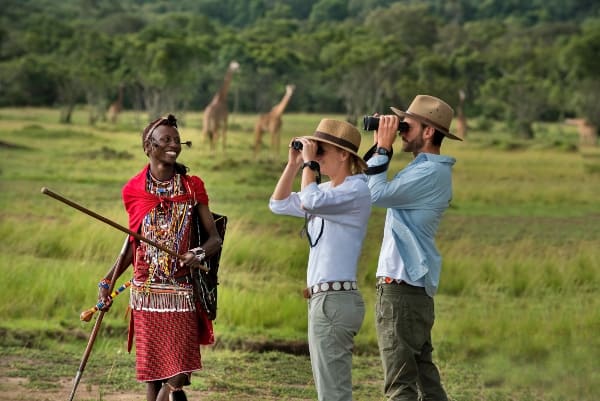
Walking isn’t permitted inside the main Masai Mara National Reserve, but the surrounding private conservancies, Naboisho, Mara North, and others, allow guided walks as part of their broader activity offerings, typically as a morning add-on to a game drive-based stay.
Serengeti and Ngorongoro Areas, Tanzania
Walking safaris in Tanzania are more limited within the core national parks but are increasingly offered in the surrounding conservation areas and as multi-day mobile walking trips through specific operators, often combined with fly-camping under canvas each night.
Uganda’s Forest and Savanna Parks
Queen Elizabeth and Kidepo Valley National Parks offer guided walks alongside their more famous primate trekking activities, and the forest walking in Bwindi and Kibale, technically guided walks in their own right, offer a completely different sensory experience from savanna walking.
Northern Kenya’s Private Conservancies
Laikipia and Samburu have built much of their identity around walking, often including multi-day walking safaris with fly-camps that relocate each night, one of the most immersive versions of this experience anywhere in East Africa.
What to Expect on a Typical Walking Safari
Walks are typically scheduled for early morning, when temperatures are cooler and animal activity is highest, and usually run two to four hours, though multi-day walking itineraries with fly-camping can stretch considerably longer.
Groups are kept small, often four to eight guests, accompanied by an armed lead guide and frequently an armed local scout carrying additional tracking expertise. The pace is deliberately slow and quiet, punctuated by frequent stops to examine tracks, discuss ecology, or simply observe. Large dangerous game, elephant, buffalo, lion, is approached cautiously and from a safe, guide-determined distance, and guides carry firearms strictly as a last-resort safety measure rather than a hunting tool. A genuine close encounter requiring intervention is rare.
When to Go
Dry season, roughly June through October in East Africa and May through September in Zambia, offers the most comfortable walking conditions: firmer ground, shorter grass for better visibility and safety, and clearer animal tracks. Walking during the wetter months is still offered at many properties but comes with muddier trails, taller grass that reduces visibility, and a higher likelihood of a walk being shortened or rescheduled around weather.
Budget Considerations
Guided walks are often included at no extra charge as part of a conservancy or camp’s standard activity offering, particularly in Kenya’s private conservancies, where the conservancy fee already covers a broad range of activities beyond game drives.
Multi-day dedicated walking safaris with fly-camping run as a specialized, higher-cost product, since they require specialist guiding staff, portable camp equipment, and a support team moving the camp between sites. Expect a meaningful premium over a standard vehicle-based safari for a dedicated multi-day walking itinerary, reflecting the specialized staffing and logistics involved.
Fitness and Age Considerations
Standard morning walks require only moderate fitness, flat to gently undulating terrain at an unhurried pace, with frequent stops built in. Multi-day walking safaris covering longer daily distances demand a higher fitness baseline and are worth discussing honestly with your consultant before booking. Most camps set a minimum age of twelve for walking activities, occasionally higher, given the safety considerations around proximity to wildlife, so this is worth checking early if you’re traveling with children.
Nature walks
What Makes a Great Walking Guide
Guide quality matters more on a walking safari than almost any other type of safari activity, since your safety and the depth of what you learn both depend directly on their skill. The best walking guides combine formal tracking certification with years of accumulated field experience, and they teach as much as they lead, explaining the reasoning behind every decision, from route choice to wind direction, rather than simply pointing things out.
A strong guide reads wind direction constantly, since animals rely heavily on scent, and a walk positioned downwind of dangerous game changes the entire safety calculation. They’ll also set a pace that matches the group’s fitness and interest level, slowing dramatically for a fresh leopard track or a chance to examine dung and feeding sign, and picking up through less interesting terrain. When we vet a new camp for our walking-safari recommendations, guide quality is the single factor we scrutinize most closely, well ahead of tent quality or menu variety.
Combining Walking With Other Activities
Walking pairs naturally with a broader multi-activity stay rather than standing alone. A typical conservancy day might open with an early walk before the heat sets in, move into a midday rest at camp, and close with an afternoon vehicle-based game drive and sundowner, giving you both the intimacy of walking and the range of a vehicle within the same twenty-four hours.
In areas with rivers or channels, a walking morning combines particularly well with an afternoon boat excursion, offering three distinct perspectives on the same ecosystem within a single day. We often build walking into the first two or three days of a longer safari specifically because the ecological literacy it builds, understanding tracks, behavior, and habitat, genuinely enhances every vehicle-based game drive that follows.
A Note on Fly-Camping
For travelers drawn to the deepest version of this experience, fly-camping, sleeping in simple, temporary canvas camps that move with a multi-day walking route, strips the safari back to its most essential form. Camps are basic by design: simple bedrolls or camp beds, bucket showers, and a small support team handling meals and logistics rather than a full lodge staff.
What you gain in exchange is genuine wilderness immersion, falling asleep to the actual sounds of the bush rather than a generator hum in the distance, and a sense of self-sufficiency a fixed luxury camp simply can’t replicate. It’s not for every traveler, but for the right one, it’s often described afterward as the most memorable few nights of an entire African trip.
How We’d Plan This
We always recommend building in at least one full walking-safari morning, even for clients who weren’t specifically seeking one out, because it consistently ranks among the most memorable parts of a trip in client feedback afterward, often more than a specific animal sighting does.
The right camp matters enormously here. Not every property offers walking, and among those that do, guide quality and training standards vary. We work specifically with camps and guides whose walking programs we trust, rather than treating it as a generic checkbox activity.
If a dedicated multi-day walking safari interests you, be honest with us about your fitness level and appetite for a more rustic, fly-camp style of accommodation, since these trips trade some comfort for a genuinely wilder, more immersive experience.
Recommendations by Traveler Type
First-time walkers wanting a taste of the experience: a single morning walk added to a Kenya conservancy stay, low commitment, high reward.
Serious naturalists and repeat safari travelers: a multi-day fly-camping walking safari in Zambia’s South Luangwa or Kenya’s Laikipia, for full immersion.
Families with older children: conservancy-based morning walks in the Masai Mara area, checking age minimums with the specific camp in advance.
Photographers: walking safaris suit macro and landscape work better than big-lens wildlife photography, worth setting expectations accordingly.
Frequently Asked Questions
Is a walking safari dangerous?
Guided walks led by properly trained, armed guides carry a strong safety record. Guides maintain strict distance protocols around dangerous game and are trained extensively in reading animal behavior to avoid confrontation entirely, which is the actual goal rather than being prepared to intervene.
Do I need to be very fit to go on a walking safari?
Standard morning walks require only moderate fitness. Multi-day walking safaris covering more ground each day require better fitness, and we’ll be upfront with you about what a specific itinerary genuinely demands.
Can children go on guided walks?
Most camps set a minimum age around twelve, sometimes higher, for safety reasons. Family-friendly walking options do exist at some properties, worth confirming directly with us for your specific dates and camp.
Will I definitely see big animals on a walk?
Not necessarily, and that’s part of the honest appeal. Walks emphasize tracking, ecology, and smaller details as much as large mammal sightings. Guides balance safety and experience over guaranteeing a specific sighting, which is exactly as it should be.