Masai Mara National Reserve
The Masai Mara national reserve sits in Narok County in southwestern Kenya, roughly 270 kilometres from Nairobi as the road runs, right where Kenya’s Rift Valley grasslands meet the northern edge of Tanzania’s Serengeti. The reserve itself covers about 1,510 square kilometres, with several private conservancies adding further wilderness around its borders.
Overview
The reserve is named after the Maasai people who still graze cattle along its boundaries, and after the Mara River that cuts through its heart, and it forms the northern extension of the same ecosystem as Tanzania’s Serengeti.
Most travellers planning their first Kenyan safari put the Mara at the top of the list, and for good reason: the density of predators here, combined with the sheer scale of the plains, makes it one of the most reliable places on the continent to watch a hunt unfold in real time.
A patchwork of private conservancies rings the reserve, effectively doubling the wilderness available to visitors who choose to stay outside its core. Open savannah dominates, broken by riverine forest along the Mara and Talek rivers, low acacia woodland, and the odd rocky outcrop that makes a natural vantage point. Lion, leopard, cheetah, elephant and buffalo are all resident year-round, and the reserve holds one of the highest lion densities in East Africa.
The reserve is typically divided into several distinct sectors for planning purposes: the Mara Triangle in the west, managed separately by the Mara Conservancy and generally regarded as having the best-maintained roads and lowest vehicle density within the national reserve itself; the central and eastern sections around Sekenani and Talek, which see the highest visitor volume given their proximity to the main gates; and the Sand River area in the far south, bordering the Serengeti directly.
Which sector you end up in depends largely on which gate and which camp you book, so it’s worth asking your operator specifically which part of the reserve your itinerary covers rather than assuming all Mara camps deliver an equivalent experience.
Best Time to Visit
July through October is peak season, when the Great Migration herds are typically present in the reserve and the dry grass makes game viewing easy — book six months to a year ahead if you want a camp near the river crossings.
The ‘green season’ from January to March offers newborn wildlife, dramatically fewer vehicles at sightings, and lower rates, though afternoon showers are common. November and the April-to-May long rains are the quietest and cheapest months, worth considering if budget or crowds matter more to you than migration timing.
A word on cost specifically: the Masai Mara is managed by Narok County rather than the Kenya Wildlife Service, and its entry fees have risen sharply under a revised 2026 schedule, now running at roughly 100 US dollars per non-resident adult during the January-to-June low season and around 200 US dollars during the July-to-December peak, a considerably steeper structure than most other Kenyan parks and worth building into your budget from the outset rather than discovering at the gate.
Masai Mara National Park
Getting There and Where to Stay
Getting There
Most visitors fly from Nairobi’s Wilson Airport, a 45-to-60-minute hop on Air Kenya, SafariLink or Governors Aviation into one of the reserve’s roughly dozen airstrips — Keekorok and Musiara among the best known. Driving takes four to six hours over roughly 270 kilometres depending on the route and road conditions, and while a self-drive is possible, most travellers prefer a private transfer or the short flight to save a full day of road time.
Which airstrip you fly into matters more than first-time visitors often realise, since the Mara’s road network within the reserve is extensive and a camp on the opposite side from your arrival airstrip can mean a genuinely long transfer before your first game drive even begins.
Musiara and Mara Serena serve the western Mara Triangle and central conservancies well, while Keekorok and Ol Kiombo sit more centrally for camps around the Talek and Sekenani areas. It’s worth confirming with your operator that your chosen airstrip lines up sensibly with your camp before booking flights independently of your accommodation.
Where to Stay
Accommodation ranges from simple tented camps to some of Kenya’s most exclusive lodges, split mainly between properties inside the national reserve itself and those in the surrounding private conservancies. Reserve-based camps put you closest to classic Mara scenery and the river crossings in migration season, while conservancy camps trade a little distance for lower vehicle density, night drives and walking safaris that the reserve doesn’t permit, and their own conservancy fees are generally charged separately from — and are typically lower than — the national reserve’s own entry costs.
Activities
What you do in the Mara depends on where you base yourself and what time of year you visit, but a handful of experiences define a Mara safari.
Game Drives
Two drives a day, one at dawn and one in the late afternoon, form the backbone of any Mara itinerary. Predators are most active in the cool hours either side of the heat of the day, so an early start genuinely changes what you see — lions finishing a night’s hunt, or a leopard dragging a kill up into a tree before the sun gets high. Drives run in open-sided 4×4 vehicles with a driver-guide who reads tracks and radios other guides to share sightings, so even a single morning can turn up several of the Big Five. Some camps also offer full-day drives with a packed lunch eaten out in the bush, useful during migration season when a promising crossing might be building at a river several hours from camp and you don’t want to break for a midday return.
Hot Air Balloon Safaris
A balloon launches before sunrise and drifts silently over the plains for about an hour, giving you a completely different read of the landscape — herds strung out across the grass, the sinuous line of the Mara River, and animals that have no idea you’re overhead because there’s no engine noise to alert them. Flights end with a champagne breakfast set up in the bush. A separate landing fee, currently around 50 US dollars per adult, applies on top of the flight cost itself, though most operators bundle this into the quoted price. Book this early in your trip if you can, since flights depend on weather and operators cap numbers per launch.
Cultural Visits to Maasai Villages
Several Maasai manyattas near the reserve gates welcome visitors for a guided walk through a working homestead, where residents explain cattle-herding practices, demonstrate fire-starting, and often perform the adumu, the jumping dance associated with warrior ceremonies. This works best as an add-on to a game drive rather than the centrepiece of a day, and it’s worth choosing a village visit arranged through your lodge rather than an informal roadside stop, since the proceeds are more reliably shared with the community.
Guided Walking Safaris and Night Drives
These aren’t permitted inside the national reserve itself, which is reserved for vehicle-based game viewing, but they are available in the private conservancies that border it — Mara North, Naboisho, Olare Motorogi and others. Walking puts you at ground level with tracks, dung, insects and birdlife you’d drive straight past, while a night drive with a spotlight is often the only way to see nocturnal hunters like leopard and hyena in action.
Birdwatching
The Mara supports over 500 recorded bird species, from the outsized Kori bustard striding through the grass to martial eagles and lilac-breasted rollers flashing between acacia trees. Birding is good year-round but peaks between November and April when Palearctic migrants join the resident population, so keen birders should plan a trip around that window if birdlife is a priority alongside mammals.
Photography-Focused Safaris
Several operators and specialist guides in the Mara run photography-specific drives, using vehicles fitted with beanbag rests, extra battery charging capacity and, on some conservancy properties, a second dedicated photographic vehicle so guests aren’t sharing a single sighting with vehicle occupants pursuing different shots. These trips generally move more slowly and stay longer at productive sightings than a standard game drive, which particularly benefits visitors chasing specific behavioural moments — a hunt, a river crossing, cubs at play — over simply covering ground.
Visiting the Mara Triangle
The reserve’s western sector, managed independently by the Mara Conservancy rather than Narok County, is worth a specific mention as an activity in its own right for travellers based elsewhere in the Mara, since its more tightly controlled visitor numbers and well-maintained road network make it a worthwhile day-trip destination even from camps in the central or eastern sections.
Attractions
Beyond the day-to-day rhythm of game drives, a few features and events give the Mara its reputation as Africa’s premier safari destination.
The Great Migration and Mara River Crossings
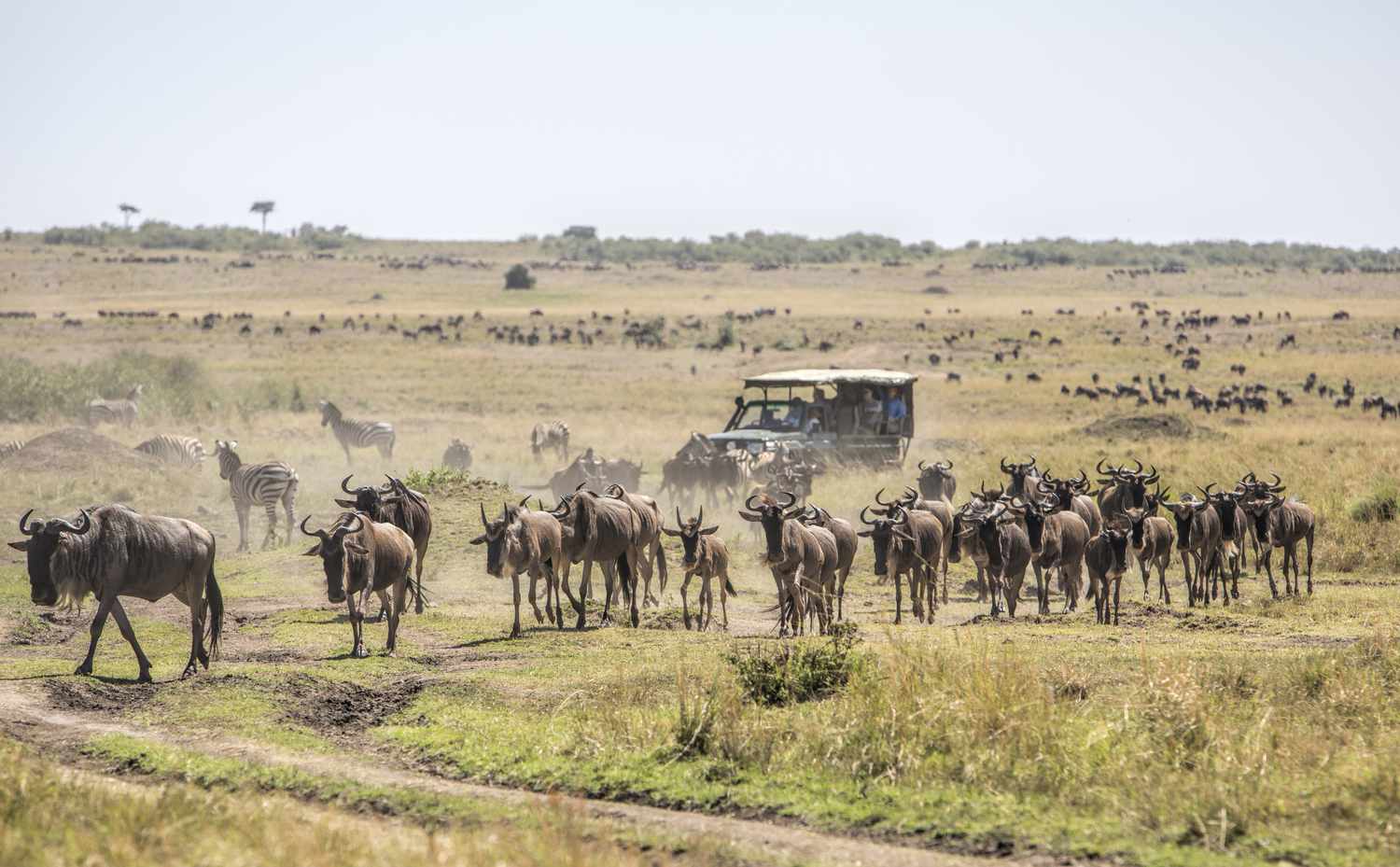
Between roughly July and October, well over a million wildebeest, accompanied by hundreds of thousands of zebra, cross from the Serengeti into the Mara in search of fresh grazing. The crossings of the Mara River are the spectacle everyone pictures — thousands of animals bunching at the riverbank, then plunging in together while crocodiles and lurking lions pick off stragglers. Crossings aren’t scheduled; they can happen at any hour and shift location from year to year, so a guide with local knowledge of herd movement matters more than a fixed itinerary if witnessing one is your priority.
The Mara River
Even outside migration season, the river itself is worth building time around. Its pools hold some of the largest resident hippo and crocodile populations in Kenya, and the riverine forest along its banks draws elephant, buffalo and a different mix of birdlife than the open plains. Sundowner stops on raised ground overlooking the river are a common and worthwhile way to end a game drive.
The Oloololo (Siria) Escarpment
This dramatic wall of rock rises along the reserve’s western edge and offers sweeping views across the entire Mara ecosystem. Lodges positioned along or near the escarpment trade a small amount of proximity to the best game-viewing areas for genuinely spectacular scenery and cooler evening temperatures.
The Maasai Beadwork Museum
Located near Sekenani Gate, this small museum displays traditional Maasai beaded artefacts and explains the symbolism behind different colours and patterns used in ceremonial dress. It’s a modest stop, best combined with a village visit, but it adds useful cultural context that a game drive alone won’t provide.
The Private Conservancies
Mara North, Naboisho, Olare Motorogi, Mara Naboisho and several others ring the reserve and operate under stricter visitor caps than the national reserve itself, which means fewer vehicles at sightings and access to activities — walking, night drives, off-road driving — that the reserve doesn’t allow. Travellers who prioritise a quieter, more flexible safari over ticking the ‘Masai Mara’ box on a map often end up happier basing themselves in a conservancy for at least part of their stay.
Musiara Marsh
A permanent wetland near the reserve’s northern boundary, Musiara Marsh has been the territory of several long-studied lion prides featured in wildlife documentaries over the decades, and it remains one of the more consistently productive areas of the Mara for lion sightings specifically, alongside strong resident hippo and waterbird populations.
Rhino Ridge
A stretch of higher ground within the reserve historically associated with black rhino sightings, Rhino Ridge is a reminder that the Mara, while not primarily known for rhino the way Nakuru or Ol Pejeta are, does hold a small, closely protected population, and guides here can speak to the ongoing effort to keep that population secure.
Wildlife Highlights
Lion Prides
The Mara holds one of the highest lion densities in Africa, and several well-studied prides — some tracked by researchers for decades — make sightings a near-daily occurrence rather than a stroke of luck.
Cheetah on the Open Plains
The reserve’s flat, open terrain suits cheetah hunting style perfectly, and daylight hunts here are watched more often than in almost any other African reserve, since cheetahs rely on speed and sightlines rather than cover.
Wildebeest and Zebra Herds
Even outside migration season, resident wildebeest and zebra populations graze the reserve year-round, so the plains rarely look empty even in the quieter months.
Leopard of the Riverine Forest
Leopard sightings in the Mara tend to concentrate around the riverine forest bordering the Mara and Talek rivers, where dense cover and overhanging branches suit both daytime resting and the species’ habit of hoisting kills out of reach of scavenging hyena and lion.
Elephant Herds
Resident elephant family groups move between the reserve and the surrounding conservancies throughout the year, and the Mara’s open terrain generally makes for excellent visibility when a herd is nearby, in contrast to the denser woodland elsewhere in Kenya where elephant sightings can be more fleeting.
Fun Facts
- The Mara River crossing is not a single event — it can happen dozens of times over several months as herds shuttle back and forth chasing fresh grass.
- The reserve takes its name partly from the Maa word for ‘spotted’, a reference to the pattern of trees, shrubs and cloud shadow across the plains.
- Some conservancies bordering the reserve cap visitor numbers so strictly that a single sighting may only ever have one or two vehicles present.
- The wider Mara ecosystem supports a disproportionate share of Kenya’s entire wildlife population despite covering a small fraction of the country’s land area.
- Entry fees are structured in three tiers — Kenyan citizens, East African residents, and non-residents — with non-residents paying roughly nine to ten times the citizen rate, a pricing model designed to keep the reserve accessible to local communities while foreign visitors fund the bulk of its conservation costs.
- The Mara Triangle, the reserve’s western sector, has been managed since 2001 by the nonprofit Mara Conservancy rather than Narok County directly, a distinct governance arrangement credited with generally better road maintenance and anti-poaching enforcement in that specific section.
- Researchers have followed some Mara lion prides continuously since the 1960s, making the reserve’s lion population data among the longest-running continuous predator studies anywhere in Africa.