6 Days Uganda Wildlife Safari
September 14, 2026
7 Days Marangu Route Kilimanjaro Climb
The Marangu Route is the only path up Kilimanjaro where you sleep in huts rather than tents at every camp, and it is often the first route new climbers consider. Nicknamed the “Coca-Cola Route,” it can technically be climbed in this 7 Days Marangu Route Kilimanjaro Climb and is the least expensive option on the mountain — but that speed comes at a cost.
We build this itinerary over seven days rather than the minimum five, adding an acclimatization day at Horombo Hut. Kilimanjaro’s summit success rates track altitude gain far more than fitness, and the extra day at 3,705 meters meaningfully improves your odds of reaching Uhuru Peak rather than turning back at Gillman’s Point. The huts along the way Mandara, Horombo, and Kibo each have solar lighting, and Horombo and Mandara have flush toilets, a comfort you will not find on Kilimanjaro’s other routes.
This route suits first-time high-altitude trekkers, budget-conscious climbers, and anyone who prefers a hut over a tent at 4,700 meters. Because the ascent and descent use the same trail, it is also the most straightforward route to navigate a genuine advantage if this is your first major trek.
Quick Facts
| Duration | 7 Days / 6 Nights |
| Start / End | Moshi |
| Route Type | Ascend and descend the same trail |
| Accommodation | Mountain huts throughout (the only Kilimanjaro route to offer this) |
| Best For | First-time high-altitude trekkers and budget-conscious climbers |
| Note | Technically climbable in 5 days; 7 days meaningfully improves summit success odds |
Highlights
- Day 1: Airport pick-up, transfer to Moshi
- Day 2: Marangu Gate to Mandara Hut
- Day 3: Mandara Hut to Horombo Hut
- Day 4: Horombo Hut, acclimatization day
- Day 5: Horombo Hut to Kibo Hut
- Day 6: Summit day — Kibo Hut to Uhuru Peak, descend to Horombo Hut
- Day 7: Horombo Hut to Marangu Gate, drive to Moshi/Arusha
Detailed Itinerary
Day 1: Airport Pick-Up, Drop-Off at Hotel
On arrival at Kilimanjaro International Airport, your driver-guide will meet you and transfer you to your accommodation in Moshi. Your guide will give you a short briefing on the following day’s climb and check your kit and equipment.
Accommodation: Moshi Salsalinero Hotel
Meal Plan: Dinner
Day 2: Marangu Gate (1,860m) to Mandara Hut (2,715m)
Hiking Time: 5 hours
Distance: Approximately 8.1 km
Habitat: Montane forest
After breakfast, transfer to the Kilimanjaro National Park gate, about a 50-minute drive through Marangu village on the mountain’s lower slopes. At the gate, all hikers sign in at the park office and make final preparations while porters load packs with food, water, and cooking gas.
From the gate, the main trail climbs a cleared ridge through rainforest, where you have the best chance of spotting wildlife on the route. An alternative, more scenic trail branches off shortly after the gate, following a stream through the undergrowth before rejoining the main trail either an hour and a half in, or an hour before Mandara Hut.
Mandara Hut is a cluster of wooden A-frame huts in a forest clearing, each with six to eight bunks and solar lighting, with a total camp capacity of 60 climbers. Water is piped in from springs above the camp, and flush toilets sit behind the main hut.
Accommodation: Mandara Hut
Meal Plan: Breakfast, Lunch and Dinner
Day 3: Mandara Hut (2,715m) to Horombo Hut (3,705m)
Hiking Time: 6 hours
Distance: Approximately 11.6 km
Habitat: Moorland
From Mandara, the trail passes through a short stretch of forest, skirts the base of Maundi Crater, and transitions from rainforest into moorland. A short detour up the rim of Maundi Crater rewards you with your first view of Kibo’s crater in the distance; on a clear morning, you will see the peak lit up in the early sun.
Once in the open moorland, you will pass some of Kilimanjaro’s most distinctive plant life, including the giant lobelia, which can grow up to 3 meters tall, and the giant groundsel (Senecio kilimanjari), which reaches up to 5 meters. After roughly six hours of trekking, you will arrive at Horombo Hut for the night.
Accommodation: Horombo Hut
Meal Plan: Breakfast, Lunch and Dinner
Day 4: Horombo Hut (3,705m) — Acclimatization Day
Horombo Hut is a small village of huts on a plateau, similar in style to Mandara but with capacity for 120 climbers, and it is usually full of energy — a mix of hikers, guides, and porters both ascending and descending.
This extra night at Horombo is built into the itinerary for acclimatization. You will take a hike toward Mawenzi Hut, passing the Zebra Rocks along the way — about three hours up and an hour and a half back down — to help your body adjust before continuing higher.
Accommodation: Horombo Hut
Meal Plan: Breakfast, Lunch and Dinner
Day 5: Horombo Hut (3,705m) to Kibo Hut (4,730m)
Hiking Time: 6 hours
Distance: Approximately 9.6 km
Habitat: Alpine desert
After breakfast, continue the ascent into alpine desert terrain. From Horombo, two trails lead to the saddle between Mawenzi and Kibo: an upper route, stony and eroded, that follows the path from your acclimatization hike, and a lower route, generally recommended, which is easier, nearly an hour shorter, and passes the last water point at 4,130 meters.
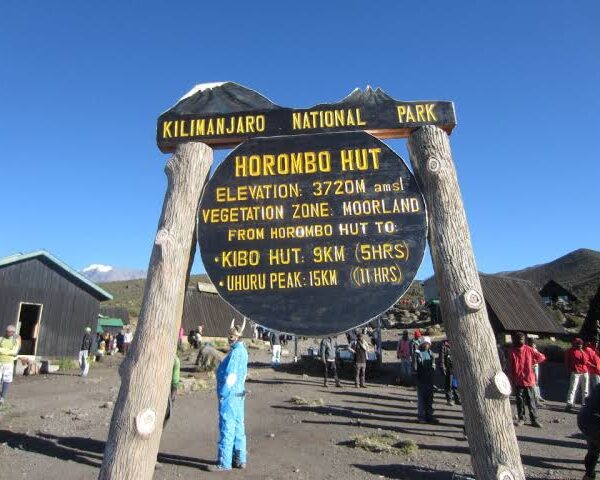
Horombo Hut
Kibo Hut sits in the barren alpine desert — a stone building with bunk beds for 60 climbers, no nearby streams, and platform toilets behind the huts. Mineral water and soft drinks are available at the camp office; fill your bottles here before the final push.
From this point, the summit is 1,195 meters above you, and you will begin your final ascent later that same night. Prepare your equipment — ski poles, thermal clothing, a spare headlamp and camera batteries — and carry water in a thermal flask to prevent it from freezing.
Accommodation: Kibo Hut
Meal Plan: Breakfast, Lunch and Dinner
Day 6: Summit Day — Kibo Hut (4,730m) to Uhuru Peak (5,895m) to Horombo Hut (3,705m)
Hiking Time: 7-8 hours to the summit; 6-8 hours to descend to Horombo
Distance: Approximately 5.4 km ascent, 15 km descent
Habitat: Stone scree and ice-capped summit
This is the toughest day of the climb, with around 14 hours of walking in total, so come prepared mentally as well as physically. You will rise around 11:20 p.m. for tea and biscuits before setting off into the dark.
The first section is a rocky path to Hans Meyer Cave (5,150 m), a good spot to rest, before the trail zigzags steeply up loose stone scree to Gillman’s Point (5,681m) on the crater rim — the most demanding section of the entire route. Move slowly and steadily; most guides call this the “Kili shuffle” for good reason.
From Gillman’s Point, you will walk through snow the rest of the way to Uhuru Peak (5,895m), the highest point in Africa. How long you spend at the summit depends on the weather, but take your photographs and take in the view before beginning the three-hour descent back to Kibo Hut.
After a short rest and gathering the gear you left behind, continue down to Horombo Hut, a further three hours away, for your overnight stay. The descent back to Horombo will feel surprisingly quick compared to the climb up. Enjoy your last dinner on the mountain before an overnight stay.
Accommodation: Horombo Hut
Meal Plan: Breakfast, Lunch and Dinner
Day 7: Horombo Hut (3,705m) to Marangu Gate (1,860m)
Hiking Time: 6 hours
Distance: Approximately 19.7 km
After breakfast, continue the six-hour descent, passing Mandara Hut on the way down to Marangu Gate. At the gate, successful climbers receive their summit certificates: a green certificate for reaching Gillman’s Point (5,681m), and a gold certificate for reaching Uhuru Peak (5,895m). From there, you will be driven back to Moshi or Arusha for a long-awaited hot shower, dinner, and a celebration.
Accommodation: Moshi Salsalinero Hotel
Meal Plan: Breakfast, Lunch and Dinner
End of Safari