10 Days Tanzania & Uganda Safari
September 18, 2026
Best Camps for Family Safaris in Masai Mara
September 18, 2026
10 Reasons Why Kenya Should Be Your Top Travel Wish List
Kenya is one of Africa’s most recognizable destinations, and it earns that reputation honestly: sweeping savannahs, a dramatic Rift Valley, a snow-capped mountain on the equator, and a coastline with centuries of Swahili history, all within a single country.
Add warm hospitality, genuinely strong conservation work, and direct flights from both the UK and the US, and it’s easy to see why Kenya keeps landing on travelers’ wish lists.
What often surprises first-time visitors is the sheer variety on offer beyond the obvious game drive. Below are ten reasons Kenya deserves a serious look, from the world-famous to the lesser-known.
- Masai Mara National Reserve
The Masai Mara is Kenya’s flagship conservation area. It isn’t the country’s largest reserve, but it forms part of the wider Masai Mara-Serengeti ecosystem, home to the Great Wildebeest Migration and all of Africa’s Big Five including lion, leopard, cape buffalo, rhino, and elephant easily spotted across its open savannah plains.
A Masai Mara safari delivers strong game viewing year-round, thanks to varied landscapes, wide open spaces, a temperate climate, and a dense resident wildlife population that includes giraffes, hyenas, elands, gazelles, and the reserve’s harder-to-spot rhinos.
- The Wildebeest Migration in the Masai Mara
Every year, more than two million wildebeest, along with zebra and gazelle, make the journey from Tanzania’s Serengeti National Park to Kenya’s Masai Mara in what’s known as the Great Migration. It is the largest overland mammal migration in the world, with herds covering roughly 800 kilometers in a clockwise loop through the Serengeti-Mara ecosystem in search of fresh, mineral-rich grazing and water.
The migrating animals spend most of the annual cycle in Tanzania’s Serengeti but pass several months in the Masai Mara’s plains, typically from July to October, including the dramatic Mara River crossings that have made the migration famous worldwide.
- Nairobi National Park
Often called the world’s only wildlife capital, Nairobi National Park sits just eight kilometers from the city center, offering an accessible safari experience with genuine Big Five sightings — including endangered rhino — set against a backdrop of skyscrapers.
Alongside lion, leopard, cape buffalo, and rhinos, the park is home to giraffes, zebras, gazelles, and antelope, plus more than 400 recorded bird species, making it a genuine birding destination in its own right.
- Fort Jesus and Old Town, Mombasa
Located on Mombasa Island, Fort Jesus (“Forte Jesus de Mombaça”) is a historic fortification built by the Portuguese between 1593 and 1596 to design by Giovanni Battista Cairati, intended to protect the port of Mombasa.
Today the fort houses a museum displaying artifacts from the era when Mombasa served as a transit point for the slave trade and regional commerce, including torture rooms and prison cells once used to hold captives before they were traded. The adjoining Old Town remains one of the standout attractions along Kenya’s Indian Ocean coastline, known for its history and its beaches.
- Lamu
Off Kenya’s northern coast, Lamu Island is a UNESCO World Heritage Site and the oldest, best-preserved Swahili settlement in East Africa, founded in the 14th century.
Cars are absent here; donkeys and boats do the work instead, moving through narrow, winding alleyways lined with traditional Swahili architecture. Largely undiscovered by mass tourism until recently, the Lamu Archipelago now offers some genuinely upscale accommodation alongside its sandy beaches at Shela and its centuries of cultural history.
- Mount Kenya
At 5,199 meters, Mount Kenya is Africa’s second-highest peak, located in the country’s central region.
It’s often called a mountaineer’s mountain, since its two highest peaks — Batian at 5,199 meters and Nelion at 5,188 meters — require technical mountaineering equipment and skill to reach. Most hikers instead aim for the third-highest summit, Point Lenana, at 4,985 meters, which is accessible without technical climbing experience.
- Amboseli National Park
Amboseli is a well-known wildlife conservation area, prized for its rich biodiversity and striking landscapes framed by Mount Kilimanjaro. Its compact size means you can cover most of what it offers in around two days, making it an efficient addition to a longer Kenya itinerary.
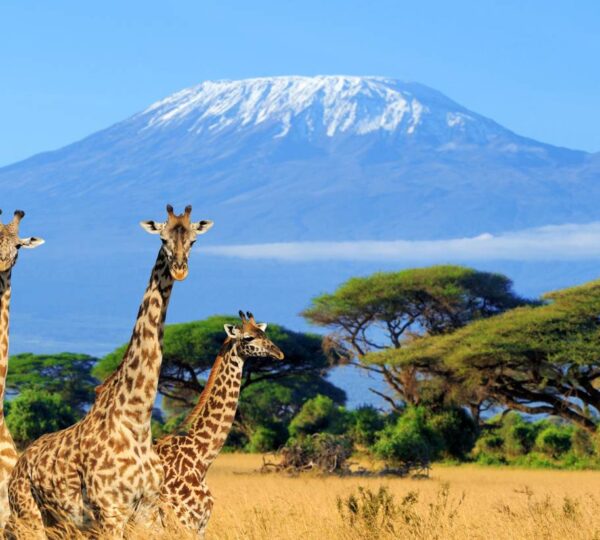
Giraffes in Amboseli
Elephants are the park’s headline draw — many are known individually by the guides thanks to decades of research by the Amboseli Elephant Research Centre — and a baboon research center adds another layer for visitors curious about these highly social, intelligent primates.
- The Karen Blixen Museum
Set in the quiet Nairobi suburb of Karen, at the foot of the Ngong Hills, the Karen Blixen Museum offers a close look into the life of the Danish author famous for her memoir Out of Africa. Her colonial-era farmhouse gives visitors real insight into Kenya’s early 20th-century history, literature, and conservation efforts.
- The Ruins of Gedi
The ruins of Gedi are a UNESCO World Heritage Site near Kenya’s Indian Ocean coast, adjacent to the town of Gedi in Kilifi District and within the Arabuko-Sokoke Forest.
Surrounded by remnant coastal forest, the abandoned city of Gedi was one of the most significant Swahili settlements on the East African coast from the 10th to the 17th centuries, part of a trade and cultural network that connected African coastal centers with Persia and beyond.
- Ol Pejeta Conservancy
Located in central Kenya’s Laikipia County, Ol Pejeta Conservancy is a 360-square-kilometer not-for-profit wildlife sanctuary sitting on the equator, west of Nanyuki, between the foothills of Mount Kenya and the Aberdares.
Ol Pejeta holds the largest rhino population in Kenya and is home to the world’s last two remaining northern white rhinos, making it arguably the best place in the country to see rhino up close. Activities include game drives, mountain biking, horseback riding, lion tracking, running with rangers, cycling, and community visits.
Established in 1988 as a cattle ranch, Ol Pejeta Conservancy has since grown into a leading wildlife sanctuary and an important conservancy for endangered species, running community development programs that fund education, water access, and infrastructure for surrounding areas.
From the Masai Mara’s migration to Lamu’s car-free streets and Ol Pejeta’s rhino conservation work, Kenya’s range is genuinely wide — safari, coast, culture, and mountains, often within the same trip. Whichever of these draws you in first, most itineraries can be built to include several of them without feeling rushed.