
Best Time to Visit Zanzibar
September 21, 2026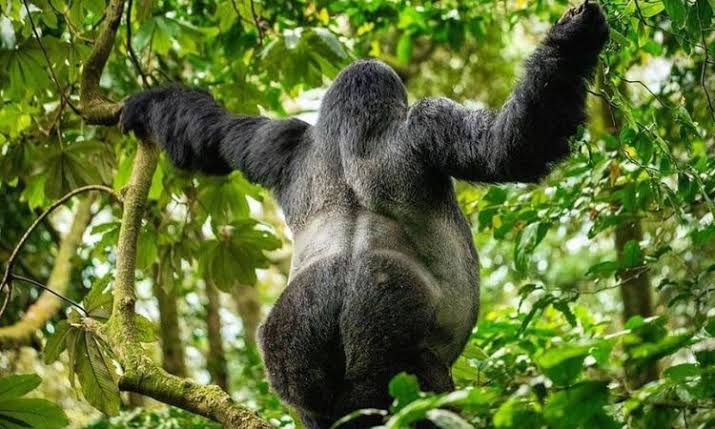
Silverback Gorilla Strength: How Powerful Is a Silverback Gorilla?
Every trekker asks some version of this question on the drive up to Volcanoes National Park or Bwindi, usually somewhere around the moment the guide explains the seven-meter rule.
How strong is the animal we are about to sit a few paces from? It is a fair question, and the honest answer is more interesting than the exaggerated numbers that circulate online, because it explains not just how powerful a silverback actually is, but why that power rarely translates into danger for a well-briefed trekker following the rules.
This guide sets out what is genuinely known about silverback gorilla strength, weight, and anatomy, separates the widely repeated estimates from the more carefully measured science, and explains what all of this means practically for anyone about to stand near one in the wild.
Why This Question Matters Before You Trek
Understanding silverback strength is not idle trivia if you are booked on a trek. It shapes why the rules exist, why your guide behaves the way they do around the family, and why the safety record for regulated gorilla trekking is as strong as it is.
A silverback that decides to charge, mock, or otherwise is demonstrating a level of physical force that no unarmed human could meaningfully resist, and every rule in the trekking briefing—distance, group size, movement, and eye contact—exists specifically to prevent that scenario from ever needing to be tested.
Travellers who understand the underlying physiology tend to follow guide instructions more precisely in the moment, because the instructions stop feeling like arbitrary caution and start feeling like the specific, evidence-based response to a specific, well-understood animal.
That is the goal of this article: less fear, more informed respect.
Silverback Anatomy: The Physical Basics
A silverback is an adult male mountain gorilla, generally over twelve years old, named for the distinctive saddle of silver-grey hair that develops across his back and hips as he matures. He is the dominant male of his family group, typically the largest individual in it, and the animal responsible for defending the group from threats, including, on rare occasions, other gorillas.
| Measurement | Typical Range |
| Standing height (upright) | About 1.5 to 1.8 meters (5 to 6 feet) |
| Body weight | Around 160 to 195 kilograms (350 to 430 pounds) on average, with some individuals reaching higher |
| Arm span | Roughly 2.3 to 2.6 meters (7.5 to 8.5 feet) |
| Sexual maturity as a silverback | Around 12 to 15 years of age |
| Lifespan in the wild | Into the 40s, with the oldest recorded Virunga silverback reaching 44 years |
The proportions matter as much as the raw numbers. A silverback’s arms are considerably longer relative to his body than a human’s, his chest and shoulder girdle are built for the demands of knuckle walking and climbing, and his bone structure, particularly through the skull, jaw, and limbs, is markedly denser and more heavily reinforced than a human skeleton of comparable size. None of this is decorative.
Every one of these features exists because wild gorillas need to move heavy bulk through dense forest, break into fibrous vegetation for food, and, for a silverback specifically, physically dominate rival males during the periodic contests that determine group leadership.
How Strong Is a Silverback, Really?
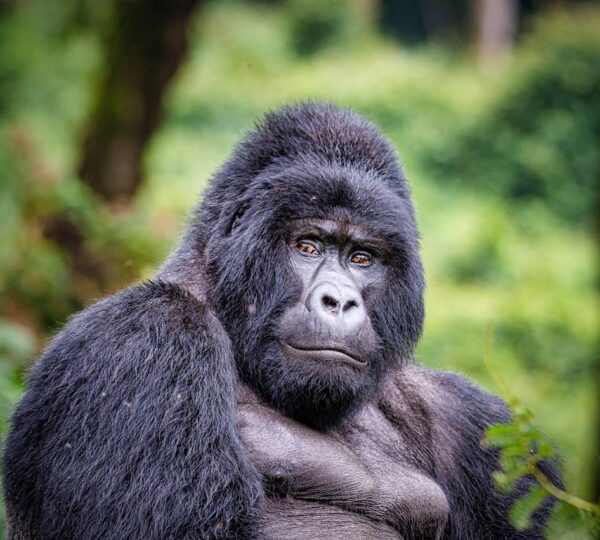
Silverback Gorilla Strength
This is where most articles either wildly overstate the numbers or repeat unverified figures without context. The honest picture has two layers: the widely cited estimates you will see across most safari and wildlife resources and a smaller body of more careful comparative research that adds important nuance to those figures.
The commonly cited estimates
Across wildlife and conservation sources, a consistent set of figures is used to describe silverback strength, generally derived from anatomical comparison and observed behavior rather than direct laboratory testing on wild gorillas, which is neither ethical nor practical to conduct.
| Measure | Silverback Gorilla | Adult Human | Approximate Ratio |
| Bite force | Around 1,300 psi (estimated) | Around 120 to 200 psi | Roughly 7 to 10 times stronger |
| Grip strength | Estimated 500 to 900+ pounds of force | Around 80 to 140 pounds for a strong adult | Roughly 5 to 8 times stronger |
| Deadlift or dragged weight capacity | Estimated up to 800 kilograms (around 1,750 pounds) | 300 to 500 kilograms for an elite trained lifter | Roughly 2 to 6 times stronger |
What more careful research adds
A widely cited 2017 study on chimpanzee muscle physiology, published after direct measurement of muscle fiber samples, found that chimp muscle generates only around 1.35 times more dynamic force per unit of muscle than equivalent human muscle, a far more modest gap than the fourfold or greater claims often repeated online.
The explanation was not that individual ape muscle cells are inherently more powerful than human ones, but that chimps carry roughly twice the proportion of fast-twitch muscle fibers, the type built for short bursts of explosive power, while humans evolved a higher share of slow-twitch fibers suited to endurance and long-distance movement.
Gorillas have not been studied in the same direct way, but the same underlying biology almost certainly applies, and it resolves what looks like a contradiction. A silverback’s muscle tissue is not some exotic super material several times more powerful pound for pound than human muscle.
What makes a silverback overwhelmingly stronger than a human in absolute terms is that he is carrying two to three times the body mass of an average man, most of it dense, fast-twitch muscle concentrated through the upper body, arms, and jaw, on a skeletal frame reinforced to handle the resulting forces. Total strength, in other words, comes from scale and fiber composition working together, not from any single dramatic biological trick.
Behavior: How Silverbacks Actually Use Their Strength
Despite the physical capability described above, silverbacks are not aggressive by default, and habituated gorilla families, the ones open to tourism, are remarkably tolerant of the humans who visit them daily under controlled conditions. Understanding the behavioral signals is as important as understanding the raw strength numbers, because it explains what you are actually likely to witness on a trek.
- Chest beating: a repeated, resonant sound produced by cupped hands striking the chest, amplified by air sacs in the throat and chest. Research on this behavior describes it as primarily communicative rather than a direct prelude to attack, used to assert size, reinforce hierarchy within the group, and deter rival males or perceived threats without resorting to physical contact
- Mock charges: a fast, deliberately loud rush toward a perceived threat that typically stops short of contact. This is a warning display, not necessarily an attack, and is the scenario your guide’s briefing prepares you for most directly
- Vocalizations: grunts, barks, and roars communicate a range of states from mild irritation to genuine alarm, and experienced trackers read these cues continuously throughout a visit, often adjusting your group’s position before a visible reaction is even necessary
- Genuine physical aggression: rare in habituated groups and, when it occurs, is overwhelmingly directed at rival gorillas during dominance contests rather than at human visitors, who are treated by habituated families as a familiar, non threatening presence after years of careful, gradual habituation by conservation teams
What This Means for Trekking Safety and Etiquette
Every rule enforced during a gorilla trek exists because of the physical realities described above, and understanding the reasoning makes the rules far easier to follow calmly in the moment rather than as a source of anxiety.
| Rule | Typical Requirement | Why It Exists |
| Minimum distance | 7 meters in Rwanda, 10 meters in Uganda | Keeps visitors outside the range where a sudden movement could be misread as a threat and reduces disease transmission risk in both directions |
| Maximum group size | 8 visitors per gorilla family | Limits the sensory and social pressure placed on the family during each visit |
| Time limit | One hour with the gorillas | Balances a meaningful encounter against minimizing stress and disease exposure risk to a genuinely endangered species |
| Face masks during close viewing | Required | Mountain gorillas share close to 98 percent of human DNA and are susceptible to human respiratory illnesses, which have caused fatalities in wild populations previously. |
| Minimum age | 15 years | Reflects both the physical demands of trekking and the judgement required to follow safety instructions precisely |
| No trekking while ill | Enforced, sometimes with a partial refund | Protects the gorillas, who have no immunity to many human pathogens, far more than it protects visitors |
If a silverback approaches or mocks charges
Your guide’s instructions in this moment are simple and specifically designed around gorilla behavior: do not run, since sudden flight can trigger a chase response in almost any animal defending territory.
Crouch down slowly, avoid direct eye contact, which gorillas can interpret as a challenge, and follow your guide’s positioning exactly. Rangers and trackers who spend their working lives with these families read early warning signs well before most visitors would notice anything, and they reposition groups accordingly, which is the main reason serious incidents during regulated treks are exceptionally rare.
Recommendations by Traveller Type
- Nervous first-time trekkers: book with an operator whose guides you trust to brief you thoroughly beforehand, and ask questions during the briefing rather than after, since a clear understanding of the rules genuinely reduces anxiety once you are standing in front of a family
- Photographers: resist the instinct to move closer for a better angle. The seven- to ten-meter rule is nonnegotiable, and a longer lens is a far better investment than proximity
- Parents trekking with teenagers: use the science in this article as a briefing tool beforehand. Teenagers who understand why the rules exist tend to follow them more precisely than those simply told to obey
- Wildlife enthusiasts wanting deeper context: ask your guide on the day about the specific family’s dominant silverback, his age, and his history within the group. Trackers often know remarkable individual detail that brings the science in this article to life
Frequently Asked Questions
Has a silverback ever seriously hurt a tourist during a regulated trek?
Serious injuries to tourists during officially regulated gorilla treks in Rwanda, Uganda, or the Democratic Republic of Congo are exceptionally rare. The layered system of experienced trackers, distance rules, and group size limits is specifically designed to prevent escalation, and the vast majority of documented incidents involving wild gorillas and humans have occurred outside tourism contexts entirely, such as historical poaching conflicts, rather than during guided visits.
Is a silverback actually stronger than a gorilla mother or younger male?
Yes, substantially, which is precisely why he holds the dominant position in the group. Silverbacks are typically twice the body mass of adult female gorillas and considerably more muscled through the chest, shoulders, and jaw, physical advantages that directly translate into their role defending the family and settling disputes with rival males.
Can a silverback really lift close to 800 kilograms?
This figure, commonly cited across wildlife sources, refers to estimated dragging or dead weight capacity rather than a clean overhead lift and is derived from anatomical modelling and comparative primate research rather than a direct measured test, since no such test has been conducted on a wild gorilla.
Even treated as an approximate estimate rather than a precise measurement, it illustrates a genuine and enormous gap over human capability, consistent with everything else known about gorilla muscle mass and bone density.
Why do guides say gorillas are gentle if they are this strong?
Strength and temperament are separate things. Mountain gorillas are predominantly herbivorous, live in stable family groups, and default to avoidance and display behavior, such as chest beating, vocalizing, and mock charging, rather than actual physical confrontation whenever possible.
Their strength exists primarily for foraging, climbing, and the occasional serious contest between rival males, not for interactions with the humans who visit habituated families under controlled, well-understood conditions.
Does a silverback’s strength change with age?
Yes. Physical power typically peaks in a silverback’s prime years, roughly from his mid-teens through his twenties, and gradually declines as he ages into his thirties and forties. This decline is one of the natural mechanisms behind leadership changes within gorilla groups, as younger, stronger males eventually challenge and sometimes replace an aging silverback.