

Kenya or Tanzania
September 19, 2026
Great Wildebeest Migration
September 19, 2026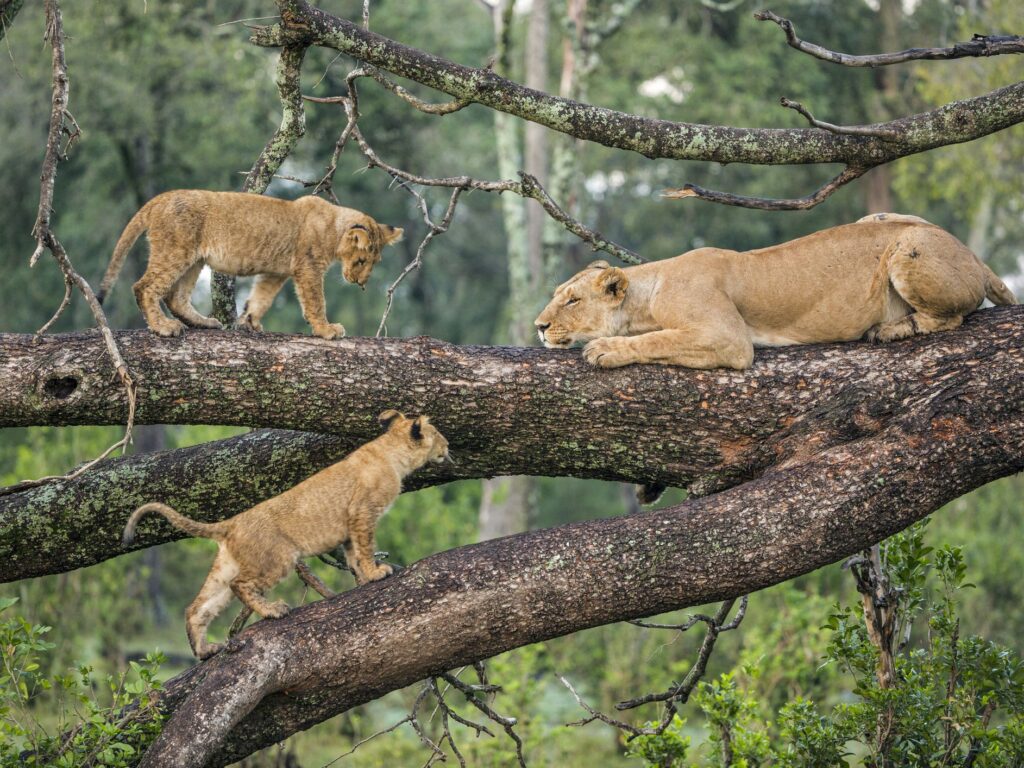
Tree Climbing Lions and Where to Find Them on Safari
You’re out on the savannah when your driver-guide excitedly points and says “lion.” Naturally, you scan the ground — but depending on where you’re safariing, it might pay to look up instead. In a handful of destinations across southern and eastern Africa, tree-climbing lions are a genuine, if unusual, part of the local wildlife story.
The idea of a “tree-climbing lion” can sound almost invented to anyone who hasn’t seen it. Even researchers and seasoned animal behaviorists agree that lions aren’t evolutionarily built for climbing and perching in branches. which is exactly why this behavior is rare enough to draw travelers to a small handful of specific parks.
While a leopard dozing in a treetop is a common enough sight on safari, this same behavior in lions has long been a subject of genuine fascination.
Can Lions Climb Trees?
Yes — a small number of prides have been documented doing exactly this. They aren’t a distinct breed or subspecies; lions simply aren’t built for climbing the way leopards are.
Lions are built for wrestling heavyweight prey like buffalo and young elephants to the ground, which comes at the cost of the agility and vertical power that lets a leopard haul an impala up a tree with apparent ease — as Luke Hunter, executive director of the Big Cats Program at the Wildlife Conservation Society in New York, has explained.
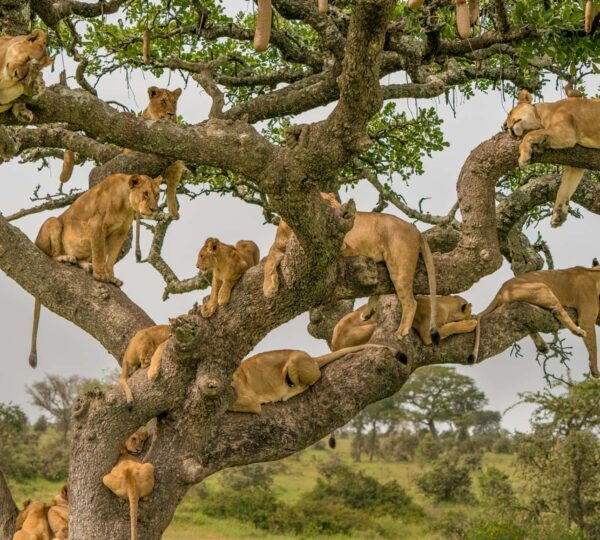
Tree Climbing Lions in Queen Elizabeth National Park
For a lion to climb successfully, the tree itself matters: horizontal branches positioned not too far above the ground tend to be the ones lions actually use.
Why Do Lions Climb Trees?
- Escaping insects — climbing is thought to be a behavioral adaptation that helps lions avoid the constant irritation of biting insects such as tsetse flies
- Staying cool — on especially hot days, the ground heats up fast, and climbing lets lions catch a cooler breeze for an undisturbed nap
- Better visibility — an elevated position gives lions a clearer vantage point for tracking prey movement across the plains
- Stealing a meal — leopards are well known for hauling prey up trees, and in some areas, lions have been observed climbing up to steal a leopard’s stashed kill
While lions aren’t physically adapted for climbing, a small number of prides have mastered the skill over time and passed it on to their young — a clear example of learned behavior rather than natural instinct. Given that lions can weigh between 250 and 400 pounds, hauling that bulk into a tree is no small feat.
Where to See Tree-Climbing Lions on Safari
If watching this behavior firsthand is on your safari wish list, consider Queen Elizabeth National Park in Uganda, Tarangire National Park and Lake Manyara National Park in Tanzania, or Kruger National Park in South Africa.
Queen Elizabeth National Park, Uganda
Uganda’s most popular game park has plenty to offer, but its tree-climbing lions, found in the Ishasha sector, are a genuine highlight — resting on the branches of sycamore fig trees.
This savannah park straddles the equator in western Uganda and features a striking mix of ecosystems: sprawling savannah, humid tropical forest, crater lakes, wetlands, and the iconic Kazinga Channel connecting Lake Edward to Lake George.
The park’s tree-climbing lions are regularly seen napping on wide branches, keenly watching grazing gazelles, antelope, and impala below — their primary prey.
Tarangire National Park, Tanzania
Famous for its distinctive baobab trees, Tarangire National Park sits in Tanzania’s northern safari circuit and is known for large elephant herds — but it’s also home to a rarer population of tree-climbing lions.
Tarangire’s skyline of fat baobab trees gives its game drives a distinctive backdrop, and the park’s healthy lion population is often seen resting among the branches of baobab and acacia trees.
With good luck, you might even catch a lion carefully picking its way down a branch before dropping to the ground — a noticeably more hesitant, awkward motion than the effortless agility of a descending leopard.
Lake Manyara National Park, Tanzania
Located in Tanzania’s Arusha and Manyara regions, Lake Manyara National Park is one of the country’s smaller reserves, with only about a third of its area being dry land. Despite its size, it holds a notably high diversity of plant and animal life.
Lake Manyara’s lions have learned to climb trees over generations, and with good fortune, you might even see cubs experimenting with the skill, playing among the branches.
Kruger National Park, South Africa
Tree-climbing lions are less common in Kruger than in the parks above, but they do occur here. The Vurhami pride, in the park’s southern region, has been known to climb trees to escape both the heat and floodwaters.
Climbing efficiently, especially for older lions, takes real effort, consistent practice, and a fair amount of arboreal skill built up over time.
Tips for Photographing Tree-Climbing Lions
Getting a strong shot of a lion in a tree takes a bit more patience than a standard ground-level sighting, mainly because of the angle involved.
- Shoot in the early morning or late afternoon, when lions are more likely to be moving in or out of a tree rather than motionless in deep shade at midday
- Position your vehicle for a clear sightline through the branches rather than directly underneath, which usually just gives you a view of the animal’s underside
- A longer lens (300mm or more) helps isolate the lion against the sky or foliage, since these sightings are often at a greater distance than a typical ground encounter
- Be patient — lions often spend hours in a tree, and the most interesting moments (climbing down, shifting position, cubs playing) tend to happen without much warning
Is This Behavior Becoming More Common?
There’s ongoing debate among researchers about whether tree-climbing is becoming more widespread or has simply always existed at a low level in scattered populations. Some biologists point to rising tsetse fly and biting insect populations, or hotter ground temperatures, as possible drivers behind lions climbing more frequently in certain parks.
Others note that the behavior has been documented in some of these same populations for decades, suggesting it isn’t a new phenomenon so much as one that’s become better known thanks to modern photography and social media.
Either way, the handful of parks where it’s reliably observed remain a genuine draw for safari-goers who’ve already seen the more common version of a resting lion on the ground.
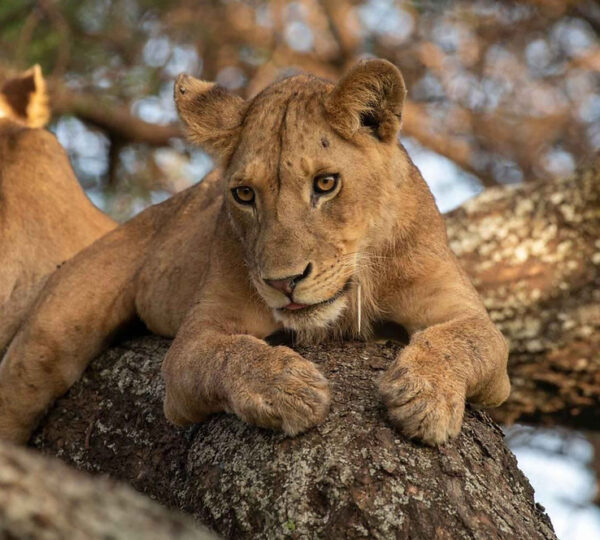
Tree Climbing Lions
What Else to See Alongside Tree-Climbing Lions
None of the four parks above are one-trick destinations, and it’s worth planning enough time to see what else they offer rather than treating the lions as the sole objective.
Queen Elizabeth National Park pairs its Ishasha lions with a Kazinga Channel boat cruise, one of the richest wildlife-viewing boat rides in East Africa, plus chimpanzee trekking in nearby Kyambura Gorge.
Tarangire is equally known for its elephant herds, often gathering in the hundreds along the Tarangire River during the dry season. Lake Manyara adds a strong birding list and one of the few groundwater forests in the region, a distinctly different habitat from the open savannah most safari parks are built around.
Building two or three nights around any of these destinations, rather than a rushed single-day stop, gives you a realistic chance at both the tree-climbing lions and the park’s other headline wildlife.
Tree-climbing lions remain one of the safari world’s genuine oddities — a learned behavior passed down through a small number of prides rather than a trait of the species as a whole. If it’s on your list, Queen Elizabeth, Tarangire, and Lake Manyara offer the strongest odds of seeing it firsthand.
Want to build a Uganda or Tanzania itinerary specifically around tree-climbing lion sightings? Our consultants know which sectors and seasons give you the best chance.