Great Wildebeest Migration
September 19, 2026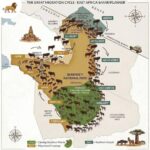
What Is the Best Month to Visit Masai Mara National Reserve?
September 20, 2026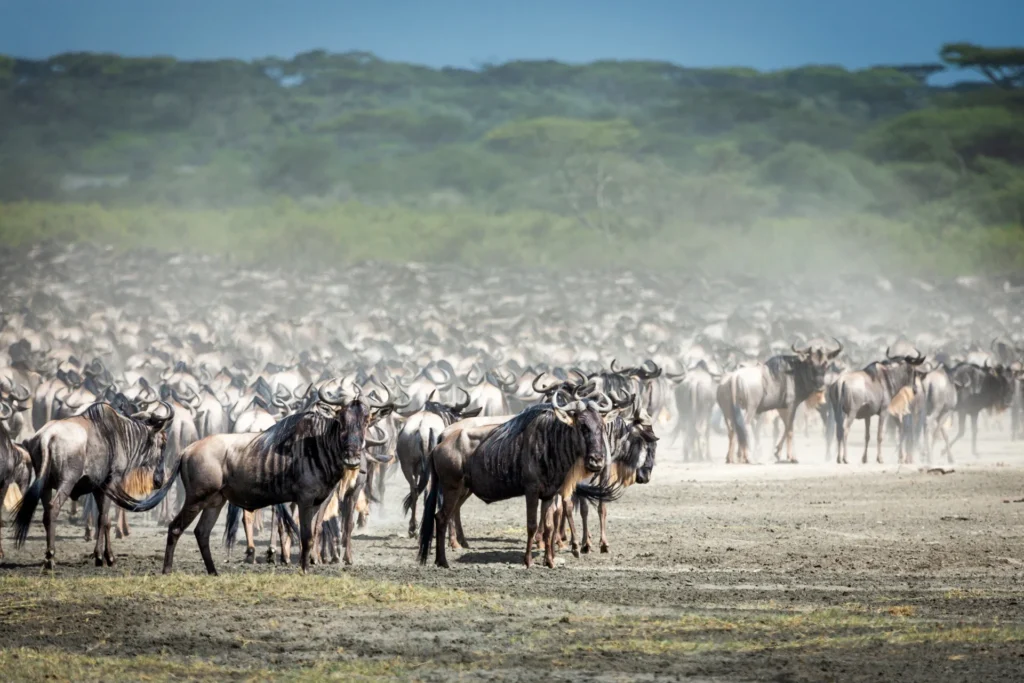
Where Is the Best Place to See the Wildebeest Migration?
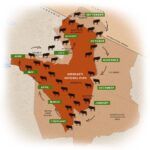
Often called the greatest show on Earth, the Wildebeest Migration is an annual movement of nearly two million wildebeest, zebra, and gazelle, traveling thousands of kilometers in a broadly clockwise loop from the southern Serengeti, north into Kenya’s Masai Mara, and back again.
It’s one of Africa’s classic safari experiences, drawing visitors year-round to witness the full circle of life along the way — mating, calving, and death, often at the jaws of the crocodiles, lions, leopards, and African wild dogs that the migration itself sustains.
The journey isn’t a straight line: herds split and reform, retrace their steps, and generally behave with more apparent chaos than the simplified version of the story suggests. And while the herds broadly follow the rains, timing isn’t an exact science, which makes pinning down the ideal location for a migration safari genuinely tricky.
For the best odds of catching the herds, consider a mobile safari camp — these properties relocate each season to follow the migration route. If your schedule allows, staying at two or three camps in different locations across the Serengeti or Masai Mara, timed to your travel dates, gives you the strongest overall chance. River crossings at the Mara and Grumeti are the most sought-after sightings, but building your entire trip around one is risky, given how unpredictable they are.
Ndutu Plains & Ngorongoro Conservation Area — For Calving and Predator Action
The Ndutu region and southern Serengeti become the birthing grounds for hundreds of thousands of calves between January and March — a period of renewal and intense predator activity.
This is the place to witness mass calving events, along with high concentrations of predators — lions, cheetahs, and hyenas — drawn by the presence of vulnerable newborns. Nearby Lake Ndutu also hosts flocks of lesser flamingos.
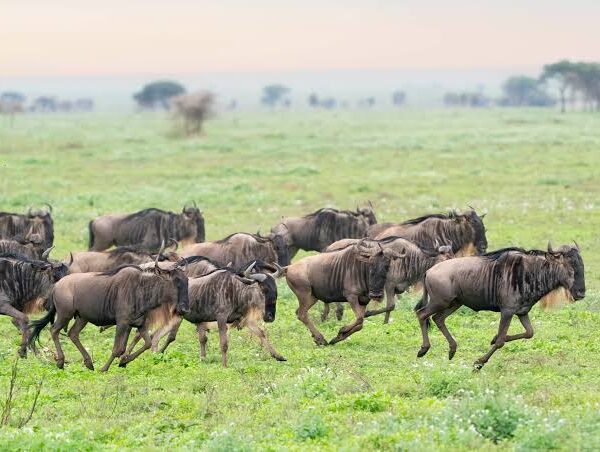
Wildebeest in Ndutu Plains
Ndutu sits adjacent to the Maswa Game Reserve, which acts as a buffer wildlife zone against encroachment and remains a key conservation area in its own right.
Central Serengeti & Seronera Region — For Year-Round Wildlife Sightings
As April arrives, herds push north into central Serengeti and the Seronera River Valley, where permanent water sources draw both migrating herds and resident predators.
The Seronera is a perennial river at the heart of the Serengeti, providing strong wildlife habitat year-round, with resident lions, leopards, and cheetahs. Thanks to consistent water and habitat, herbivores such as zebra, Bohor reedbuck, and Grant’s gazelle are found here throughout the year, migration or not.
In this region, expect resident big cats, flamingos at nearby Lake Magadi, and iconic rock outcrops like Simba Kopjes and Moru Kopjes, which offer panoramic views and Maasai rock art.
The Western Corridor & Grumeti River — For Quieter River Crossings
In May and June, herds move westward toward the Grumeti River, their first significant obstacle of the annual journey. Crossings here are smaller and less famous than at the Mara, but still filled with drama.
Fewer visitors travel through this region at this time of year, making for a more private, intimate migration experience.
Northern Serengeti & Kogatende — For the Iconic Mara River Crossings
From July to October, the bulk of the herds push north through the Ikorongo Reserve toward Kogatende and Lamai, reaching the Mara River — home to the migration’s most thrilling moments.
Here, you’ll witness daily river crossings as wildebeest plunge into crocodile-filled water, alongside resident predators including established lion prides, with typically fewer crowds than on the Kenyan side of the border.
Masai Mara National Reserve, Kenya — For the Northern Stage of the Migration
Between July and October, migrating herds cross the border into Kenya’s Masai Mara. Expect chaotic Mara River crossings, denser crowds during peak months, and excellent odds of seeing all of the Big Five in a single game drive.
The Mara River runs through the heart of the reserve, making this prime crossing territory. During these months, herds criss-cross the river in a genuinely chaotic scramble, desperately avoiding the crocodiles waiting below the surface.
Though more compact than the Serengeti, the Masai Mara’s rich biodiversity and photogenic landscapes keep it a perennial favorite.
Eastern Serengeti & Gol Kopjes — For Big Cats
As the migration turns south again in October and November, herds pass through the eastern Serengeti, where vast grassland meets acacia-studded savannah and rocky outcrops such as the Gol Kopjes.
At this stage, expect to see the herds regrouping ahead of their return journey to Ndutu.
Loliondo and Lobo — Remote Wilderness Trails
On the return journey, herds pass through Loliondo and Lobo, quiet, less-visited areas that offer a glimpse into traditional Maasai life alongside genuinely untouched wilderness.
The Return South: Lake Natron and Ol Doinyo Lengai
As the migration completes its loop, many herds pass near Lake Natron, a striking soda lake and breeding site for lesser flamingos. Nearby stands Ol Doinyo Lengai — “the Mountain of God” — a sacred Maasai volcano that adds a further layer of drama to the closing stage of the migration story.
Should You Stay at a Mobile Camp or a Fixed Lodge?
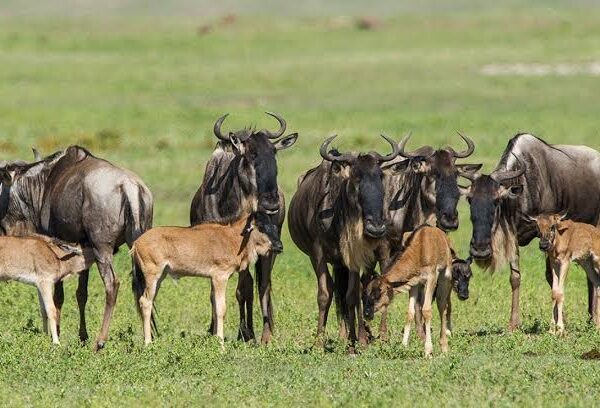
Wildebeests
This is one of the more consequential decisions in planning a migration-focused trip. A mobile tented camp physically relocates two or three times a year, following the herds between the southern plains, the western corridor, and the north — meaning wherever the migration is, a mobile camp operator is likely to have a property nearby during that specific season.
A fixed lodge, by contrast, stays in one location year-round. This isn’t a downside if that location happens to suit your travel dates, and fixed properties often offer more infrastructure and comfort than a mobile camp can. But if you’re traveling specifically to catch a river crossing or the calving season, a mobile camp timed to that season removes a layer of guesswork a fixed lodge simply can’t match.
For longer trips, many travelers split their stay across two locations — for example, several nights in the central Serengeti followed by a few nights in the north during crossing season — to hedge against the migration’s natural unpredictability.
How Long Should You Stay in Each Region?
| Region | Best Season | Suggested Stay |
| Ndutu Plains | January – March (calving) | 3-4 nights |
| Central Serengeti / Seronera | Year-round | 2-3 nights |
| Western Corridor / Grumeti | May – June | 2 nights |
| Northern Serengeti / Kogatende | July – October (crossings) | 3-4 nights |
| Masai Mara | July – October (crossings) | 3-4 nights |
Frequently Asked Questions
Can I see the migration and Ngorongoro Crater in one trip?
Yes, and this is one of the most common combinations we build. Ngorongoro Crater sits close to the southern Serengeti and Ndutu, making it a natural addition to a calving-season itinerary, or a strong finishing point after a few days following the herds further north.
Do I need a 4×4 to follow the migration?
Yes — most migration viewing happens on unpaved tracks, and some of the more remote crossing points require genuine off-road capability, particularly during or just after rain. Any reputable safari operator will already be using appropriately equipped vehicles as standard.
Is the migration equally visible from both the Kenyan and Tanzanian sides of the Mara River?
Broadly, yes, though the northern Serengeti (Tanzania) side tends to have fewer vehicles at any given crossing point than the Masai Mara (Kenya) side during peak season, simply because more visitors concentrate on the Kenyan side. Travelers specifically seeking a quieter crossing experience often lean toward the Tanzanian side for this reason.