
Serengeti Tours
September 19, 2026
Where to Go for Road Trips in Kenya?
September 19, 2026
Why Are Kenya Safaris Expensive?
A Kenya safari sits near the top of many travelers’ bucket lists, promising some of the most thrilling and memorable experiences in travel, from dramatic savannah landscapes to pristine Indian Ocean beaches.
“Why are Kenya safaris expensive?” is a question we hear often, and the honest answer involves several compounding factors: the duration of your trip, the type of accommodation you choose, and the specific activities on your itinerary. Below, we break down the biggest drivers of cost.
1. Distance and Infrastructure
Unlike travel in countries such as the US, China, or across much of Europe, where extensive infrastructure (airports, highways, rail, and hotels) and market competition keep costs down—traveling within Kenya carries real logistical costs.
Outside the capital, Kenya has airstrips rather than full airports, limiting how many guests can arrive and depart at once, with no large jet-fuel tankers on hand, meaning every drop of fuel has to be transported at real expense. Roads can be unpaved and are sometimes washed out during the rainy season.
Kenya also lacks the extensive network of buses, trains, or low-cost carriers found in more developed regions. Instead, private operators handle transportation directly, including road transfers, charter flights, and day tours—all of which add cost compared to public transit alternatives.
2. National Park Entry Fees
Visiting Kenya’s national parks, game reserves, and conservancies requires a conservation fee for every day spent inside these protected areas. These fees fund the extensive management needed to protect the land and wildlife.
This cost is usually built into your overall safari package, with funds flowing to national parks, private reserves, and, in the case of conservancies, indigenous landowners directly.
These fees may add to the overall cost of your trip, but they’re a direct, necessary contribution to wildlife conservation—and a genuine incentive for local communities to keep protecting Kenya’s wilderness and ecosystems.
3. Remote Locations
Most safari lodges and camps in Kenya sit far from any major town, which means they have to be largely self-sufficient. Everything from food to soap has often traveled hundreds of kilometers over rough roads, sometimes by ferry across rivers and lakes—a journey that can take up to two days by road versus roughly two hours by air.
Flying in supplies is even more expensive than trucking them in. National parks and reserves have no shops on-site, and the nearest store might be more than 200 kilometers away along an infrequently used road. Keeping a remote lodge running smoothly under these conditions requires careful logistics planning, and that operational overhead is a genuine driver of the overall cost.
4. All-Inclusive Accommodation Rates
You’ll likely come across the term “all-inclusive” while planning a Kenya safari—a fixed daily rate per person that covers accommodation, meals, snacks, standard drinks, and safari activities like game drives and hot air balloon flights.
It can feel expensive at first glance, but an all-inclusive rate genuinely delivers value for what you’re getting. In a remote location, your camp or lodge has to provide nearly everything—there are no nearby restaurants to visit or supermarkets to stock up at, unlike a standard hotel stay that might only include breakfast.
The upfront cost of an all-inclusive safari covers far more services and experiences than accommodation alone. Staying at a safari lodge means you never have to think about where to eat or what to do—your tour operator takes care of it. Between meals, snacks, drinks, and game-viewing activities, you’ll spend little beyond the initial cost, making an all-inclusive safari a genuinely worry-free way to experience Kenya.
5. Skilled, Specialized Staff
A good driver-guide is trained not just to drive but to track animals, interpret behavior, and know a park’s terrain well enough to be in the right place at the right time—skills that typically take years to develop. Camps also employ trackers, rangers, and hospitality staff who often live on-site for weeks at a time, away from their families, to keep a remote property running.
These are genuinely skilled jobs, and reputable operators pay accordingly. Camps that cut costs here usually do so by hiring less experienced staff, which tends to show up in the quality of your sightings and your overall experience.
6. A Deliberately Low-Density Tourism Model
Many of Kenya’s best safari areas, particularly the private conservancies bordering the Masai Mara, cap the number of vehicles and beds allowed per square kilometer. This is a conservation decision as much as a business one—fewer camps and vehicles mean less pressure on wildlife and habitat, but it also means each property has fewer guests over which to spread its fixed costs.
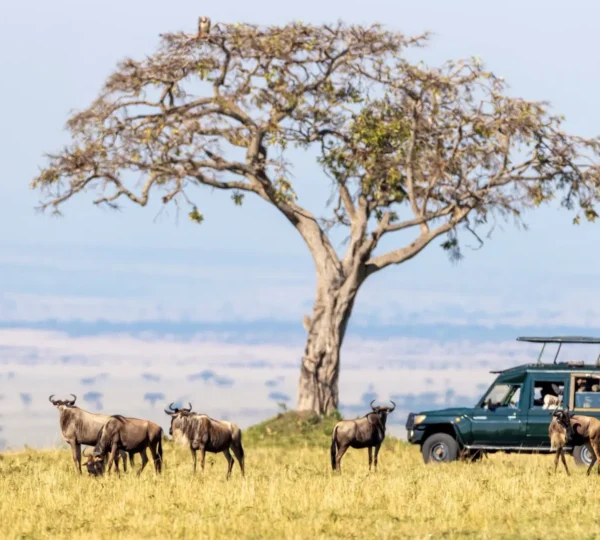
Wildebeests
This is part of why a conservancy stay costs more than an equivalent night in a busier public reserve: you’re paying, in part, for the lower density itself.
How to Manage Costs Without Compromising the Experience
- Travel during the shoulder or low season (November or April-May) for meaningfully lower rates at the same properties
- Choose a midrange conservancy stay over a big-name luxury lodge—many midrange conservancy camps deliver excellent guiding and a genuinely private experience at a lower nightly rate
- Book a longer stay at fewer camps rather than a fast-paced multi-park circuit—fewer transfers means lower transport costs
- Travel in a small group where possible, since vehicle and guide costs are typically shared per group rather than charged strictly per person
Is a Kenya Safari Worth the Cost?
For most travelers, yes—but it helps to reframe the question. A Kenya safari isn’t priced like a hotel stay because it isn’t really comparable to one: the daily rate is closer to a package covering transport, expert guiding, full board, park conservation, and accommodation that had to be built and supplied under genuinely difficult logistical conditions, all rolled into a single figure.
Compared to other bucket-list travel experiences in the same price range—a week at a five-star resort, a guided trek in the Himalayas, an Antarctic expedition cruise—a Kenya safari holds up well on a value-per-day basis, particularly given the density and quality of wildlife encounters most itineraries deliver.
How Kenya’s Costs Compare Regionally
It’s worth noting that Kenya is not the most expensive safari destination in Africa, nor the cheapest. Botswana’s high-value, low-volume model generally prices higher than Kenya at every tier, given its even more exclusive conservancy system. South Africa tends to be more affordable at the budget and midrange levels, thanks to a more developed self-drive infrastructure in parks like Kruger. Tanzania sits close to Kenya in overall cost but often runs slightly higher due to longer transfer distances between its major parks.
Kenya’s position—solidly mid-pack regionally, with genuine options at every budget tier—is part of why it remains such a popular entry point for first-time African safari travelers.
A Final Word on Value
It’s easy to compare a Kenya safari against a beach resort or a European city trip and conclude it’s expensive by comparison. That comparison misses what you’re actually buying: a small, remote operation staffed by trained guides and support crew, running under genuinely difficult logistics, delivering wildlife encounters that simply can’t be replicated closer to home.
Viewed that way, the price reflects the scarcity and effort behind the experience rather than an arbitrary premium, and most travelers who’ve been on safari come away agreeing it was worth every dollar.