
Is the Canopy Walk Safe in Nyungwe Forest?
March 30, 2026
Packing List For a Uganda Walking Safari
July 21, 2026
Fascinating Facts About Mountain Gorillas
Mountain gorillas are among the most magnificent and captivating animals on earth, gentle giants of the misty African forests who share an astonishing amount in common with us. To sit quietly and watch a family of mountain gorillas, a huge silverback surveying his troop, mothers cradling their infants, and youngsters tumbling in play, is to witness a world both wonderfully wild and startlingly familiar.
These remarkable primates, found in only a few small pockets of central Africa, have become a symbol of both the wonder of the natural world and the hope of conservation, and learning about them deepens the awe of anyone lucky enough to encounter them.
Mountain gorillas are also one of conservation’s greatest success stories. Once teetering on the very brink of extinction, their numbers have slowly climbed back thanks to decades of dedicated protection, making them one of the few great ape populations actually growing rather than declining.
Yet they remain rare and vulnerable, found nowhere in captivity and only in the wild, which makes every fact about their lives, their biology, their behaviour, and their survival all the more precious and fascinating. Understanding these animals is the first step to appreciating why they matter so much.
This guide shares a collection of fascinating facts about mountain gorillas, covering who they are, where they live, how they look and behave, their family life, their intelligence, and their remarkable conservation story.
Whether you are planning to trek to see them or simply love wildlife, these insights will help you understand and appreciate these extraordinary animals, and perhaps inspire you to experience them for yourself in the forests of Uganda, Rwanda, or the Democratic Republic of Congo.
Who Are the Mountain Gorillas?
Mountain gorillas are a subspecies of the eastern gorilla, one of the two gorilla species, and they are distinct from their lowland cousins in several ways, adapted to life in cool, high-altitude forests. They are among the largest and most powerful primates on earth, and among our closest living relatives, sharing a remarkable amount of our biology and behaviour.
- Mountain gorillas share around 98 percent of their DNA with humans, making them, along with the other great apes, among our closest living relatives.
- They are a subspecies of the eastern gorilla, scientifically known as Gorilla beringei beringei, distinct from lowland gorillas.
- They are among the largest living primates, with adult males, the silverbacks, being especially massive and powerful.
- Unlike some other gorillas, mountain gorillas have longer, thicker fur, which keeps them warm in the cold, high-altitude mountain forests where they live.
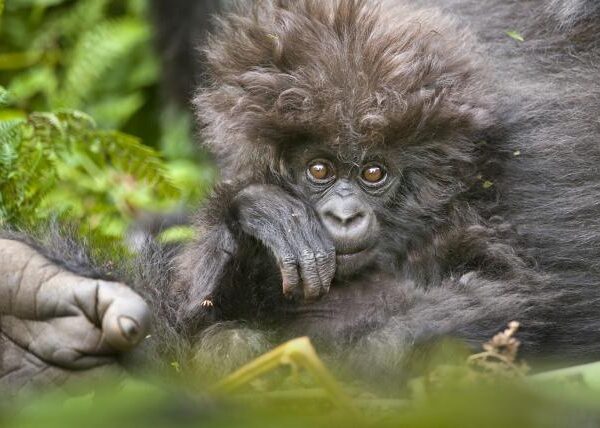
Baby Gorilla
Where Do Mountain Gorillas Live?
One of the most remarkable facts about mountain gorillas is just how rare and geographically restricted they are, found in only two small areas of central Africa and nowhere else on earth. This tiny range is part of what makes seeing them so special and their conservation so critical.
- Mountain gorillas live in only two places: the Virunga Mountains, a chain of volcanoes spanning Rwanda, Uganda, and the Democratic Republic of Congo, and the Bwindi Impenetrable Forest in Uganda.
- They inhabit high-altitude forests, generally between around 2,200 and 4,000 metres above sea level, in cool, misty, mountainous terrain.
- They are found in three countries: Uganda, Rwanda, and the Democratic Republic of Congo, which share the responsibility for their protection.
- Crucially, mountain gorillas cannot survive in captivity and exist only in the wild, so they are found in no zoo anywhere in the world.
Size, Strength, and Appearance
Mountain gorillas are imposing animals, immensely strong yet generally gentle, and their physical characteristics are a big part of their majesty. Understanding their size and features adds to the awe of encountering them.
- Adult male mountain gorillas, the silverbacks, can weigh around 160 to 200 kilograms or more and stand up to around 1.7 metres tall when upright, with females roughly half the size.
- Despite their bulk, they are primarily herbivorous, and their great size is built almost entirely on a diet of vegetation.
- Mature males are called silverbacks for the distinctive saddle of silver-grey hair that develops across their backs as they reach maturity, around twelve years of age.
- Gorillas have immense upper-body strength, estimated to be many times that of a human, yet they very rarely use it aggressively against people.
- Each gorilla has a unique nose print, the pattern of wrinkles around the nose, which researchers use to tell individuals apart, much like human fingerprints.
What Do Mountain Gorillas Eat?
Mountain gorillas are gentle vegetarians for the most part, and their feeding habits shape much of their daily life, as they spend a great deal of time simply eating. Their diet is a fascinating aspect of their biology.
- Mountain gorillas are primarily herbivorous, feeding mainly on leaves, shoots, stems, roots, and bark, along with some fruit, flowers, and occasionally small invertebrates such as ants.
- They eat a huge quantity of vegetation each day, with large males consuming up to around 18 to 30 kilograms of food daily to sustain their great size.
- They get most of the water they need from their moist, leafy diet, so they rarely need to drink from streams or pools.
- They spend much of their day feeding, resting, and digesting, moving slowly through the forest as they browse.
Family Life and Social Structure
Some of the most touching facts about mountain gorillas concern their rich family and social lives, which in many ways mirror our own. They are deeply social animals living in close-knit family groups bound together by strong relationships.
- Mountain gorillas live in stable family groups called troops, usually numbering from a few to around thirty or more individuals, led by a dominant silverback.
- The silverback is the leader, protector, and decision-maker of the group, choosing where to feed and rest and defending the troop from danger.
- Troops typically include the dominant silverback, several adult females, their young, and sometimes younger subordinate males called blackbacks.
- Bonds within the group are strong and affectionate, with grooming, play, and close contact helping to maintain relationships.
- Young gorillas enjoy a long, protected childhood, staying close to their mothers for years and learning through play, much as human children do.
Reproduction and Growth
The way mountain gorillas reproduce and raise their young is remarkably similar to humans, and it is central to understanding both their family life and their conservation. Their slow rate of reproduction is one of the key facts about the species.
- Female mountain gorillas have a gestation period of around eight and a half months, close to that of humans, and almost always give birth to a single infant.
- Newborn gorillas are tiny and helpless, weighing only around two kilograms, and depend entirely on their mothers for the first years of life.
- Infants are carried by their mothers, first clinging to the chest and later riding on the back, and are nursed for around three to four years.
- Because of this long period of care, females give birth only once every four years or so, meaning the population grows slowly.
- Mountain gorillas can live for around 35 to 40 years or more in the wild.
Intelligence and Behaviour
Mountain gorillas are highly intelligent animals, capable of emotion, communication, and even tool use, and their behaviour reveals minds far more sophisticated than many people imagine. These facts highlight just how remarkable they are.
- Gorillas are very intelligent, capable of using tools, solving problems, and, in captivity, some individuals have even learned elements of sign language.
- They communicate through a rich range of sounds, including grunts, hoots, and barks, as well as gestures, facial expressions, and body language; researchers have identified many distinct vocalisations.
- Gorillas display emotions we recognise, including joy, grief, curiosity, and affection, and have been observed to mourn dead companions.
- The silverback may beat his chest, a famous display, to communicate, intimidate rivals, or show dominance, producing a sound that carries through the forest.
- Despite their fearsome reputation, gorillas are generally shy, peaceful, and gentle, using displays rather than violence to resolve most conflicts.
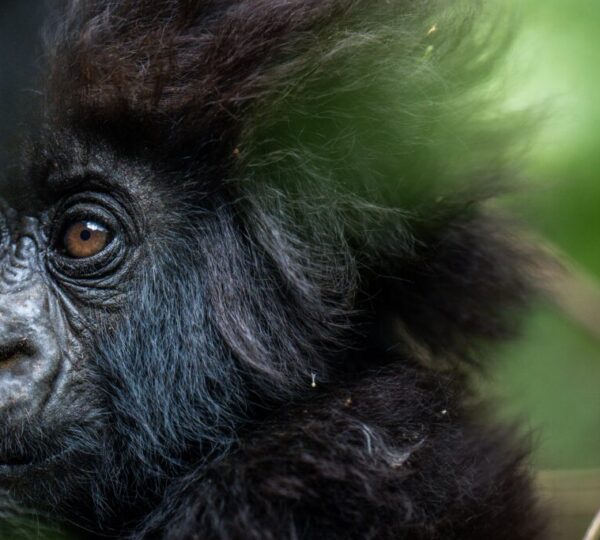
Gorilla
A Conservation Success Story
Perhaps the most important and hopeful facts about mountain gorillas concern their conservation, for they represent one of the world’s most encouraging wildlife recovery stories, brought back from the very edge of extinction. Their survival is a testament to what dedicated conservation can achieve.
- Mountain gorillas were once feared to be heading for extinction, with numbers dropping to around only 250 to 300 individuals in the 1980s.
- Thanks to decades of intensive conservation, their numbers have grown to over 1,000 individuals today, and they are one of the few great ape populations increasing rather than declining.
- Because of this recovery, their conservation status was improved from critically endangered to endangered, a rare and hopeful step in the right direction.
- They remain threatened by habitat loss, disease, poaching, and human conflict, so continued protection is essential to their survival.
- Responsible gorilla tourism plays a vital role, as the revenue from trekking permits funds the protection, rangers, and community support that safeguard the gorillas.
This success is deeply tied to the work of dedicated conservationists, including the famous researcher Dian Fossey, whose pioneering study and passionate protection of the mountain gorillas in Rwanda brought global attention to their plight and helped inspire the conservation efforts that continue to save them today. The mountain gorilla story shows that with commitment and care, even the most endangered animals can be brought back from the brink.
Mountain Gorillas and People
The relationship between mountain gorillas and humans is a fascinating and important aspect of their story, shaped by our closeness, our impact, and our responsibility towards them. These facts highlight the special bond and the care it demands.
- Because gorillas share so much of our DNA, they are highly susceptible to human diseases, which is why strict rules protect them from infection during treks, including keeping a distance and wearing masks.
- Some gorilla families have been carefully habituated to human presence over a long period, allowing visitors to observe them respectfully without disturbing their natural behaviour.
- Gorilla trekking, where small groups of visitors spend a limited time with a gorilla family, is strictly managed to protect the animals and generate vital conservation funding.
- Local communities are increasingly involved in and benefiting from gorilla conservation, giving them a stake in protecting these animals for the future.