Ultimate Guide of Where to Go For Uganda Wildlife Safaris
July 21, 2026
Best Time to Visit Uganda
July 21, 2026
Guide to Where to Go for Walking Safaris in Uganda
Walking safaris in Uganda offer a dimension of wildlife experience that no vehicle can replicate. The approach is slower and quieter. The range of detail available to you is broader: animal tracks in the dust, the smell of elephant before you see it, the sound of something large moving in vegetation fifty metres to the right, the texture of a spider’s web stretched between two branches at eye level with morning dew still on it.
You are in the environment rather than observing it through a window, and that specific quality of immersion changes how you relate to everything you encounter.
Uganda is particularly well-suited to walking safaris for reasons that go beyond the general arguments for walking. The country has 1,080 recorded bird species, the highest density in Africa per square kilometre, and a significant proportion of them are small, canopy-level, or forest-interior species that are most productively encountered on foot with a guide who knows their calls.
Uganda has forest ecosystems in Bwindi, Kibale, and Semuliki that are only properly experienced at walking pace. And Lake Mburo National Park is one of the very few national parks in Uganda where walking among large game animals on the open savannah is permitted, partly because the absence of lions in most of the park reduces the risk profile enough to make it possible.
This guide covers every worthwhile walking safari destination in Uganda, the specific trails and experiences available at each, what to bring and what to expect, and how to plan a walking-focused Uganda itinerary.
Lake Mburo National Park
Lake Mburo National Park is the most accessible and the most recommended destination for a classic open savannah walking safari in Uganda. It is the only national park in Uganda where walking among large game animals on the open plains is widely and routinely offered, and the reason is the park’s predator profile.
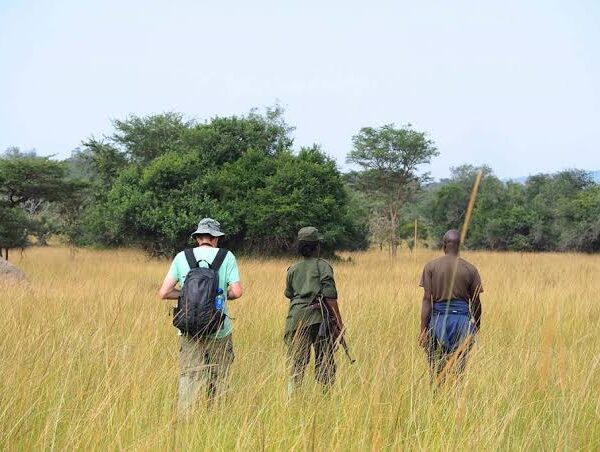
Walking Safaris in Lake Mburo
Lake Mburo has no lions and no elephants in significant numbers. The wildlife present, zebras, impalas, elands, topi, waterbucks, warthogs, hippos, Rothschild’s giraffes, and buffaloes, is engaging and close and not routinely dangerous in the way that a lion or an elephant herd on foot would be. The ranger is armed and trained, as on all Uganda walking safaris, but the combination of wildlife present and the park’s scale gives walking here a different atmosphere from a walk in a lion country park: less adrenaline and more intimacy.
Kidepo Valley National Park
Kidepo Valley National Park in Uganda’s far northeastern corner is the country’s most remote and wildest park, and the walking safari experience here is qualitatively different from anything available in the western parks. The Narus Valley, the park’s primary game viewing area, is an open semi-arid plain ringed by mountains and dramatic escarpments.
The landscape feels completely different from the equatorial green of the western circuit: harder, drier, more open, and under the direct sun of the northeast, more intensely lit. A walking safari in Kidepo moves through landscape that looks and feels like a completely different country from the forests and lake systems of western Uganda.
Walking safaris in Kidepo are conducted with armed UWA rangers and cover sections of the Narus Valley floor and the rocky escarpments at the valley edges. The Narus Valley has a large buffalo population, and the open terrain allows the ranger to position the group at a viewing distance that is both close and safe.
Lions are present and their presence is what distinguishes Kidepo walking from Lake Mburo walking: the ranger’s attention is more consistently directed toward reading the landscape for threat rather than purely for observation, and that awareness permeates the walk in a way that raises the level of engagement for most visitors. This is not a negative aspect of the Kidepo experience. It is exactly what makes a lion-country walking safari feel different from a walk where large predators are absent.
Bwindi Impenetrable Forest
Bwindi Impenetrable National Park is where most walking safari visitors in Uganda encounter their first forest on foot, because the gorilla trek itself is a walking safari by any other name. The gorilla trek can take between forty minutes and seven hours depending on where the gorilla family has ranged, and every minute of the walk before the gorilla encounter is a guided forest walk through one of Africa’s oldest and most biodiverse tropical rainforests.
The forest holds 120 mammal species, over 350 bird species, 220 tree species, and a plant diversity that reflects its unbroken age: parts of Bwindi have been forested continuously for over 25,000 years, including through the dry periods that cleared most of equatorial Africa.
Kibale Forest National Park
Kibale Forest National Park near Fort Portal is most visited for chimpanzee trekking, but the guided forest walks available inside the park outside the trekking permit system give a Kibale forest experience at lower cost that is often the more contemplative and in some ways more revealing activity.
The forest walk in Kibale is structured differently from the chimp trek: it is not oriented toward a specific animal encounter but toward the forest itself, its ecology, its plants, its birds, and the smaller wildlife that makes up most of the living content of a tropical rainforest.
A three-hour morning forest walk in Kibale with an experienced ranger covers sections of the trail network near the Kanyanchu Visitor Centre through primary rainforest at around 1,500 metres altitude. The light in the Kibale understorey in the early morning is filtered and shifting, and the forest is loud with bird calls that most visitors cannot initially separate into individual species.
The guide’s ability to identify birds by call, locate them in the canopy by the direction of the call, and move the group into position to see them before they move is the specific skill that makes a Kibale forest walk rewarding rather than frustrating. The African Pitta, the Green-breasted Pitta, and various hornbill species are among the birds most sought after on Kibale forest walks.
Murchison Falls National Park
Murchison Falls National Park is primarily visited for its Nile boat cruise and game drives on the Buligi circuit, but it offers two genuinely worthwhile walking safari experiences that most visitors miss because the boat cruise and game drive fill the available days.
The Top of the Falls Hike
The walk from Baker’s Point at the base of Murchison Falls to the top of the falls on the north bank covers approximately four kilometres of trail through the riverine woodland above the gorge and takes around forty-five minutes to an hour each way. Most visitors who do the Nile boat cruise disembark at Baker’s Point at the end of the upstream journey and complete the top-of-the-falls walk before the vehicle collects them at the road above.
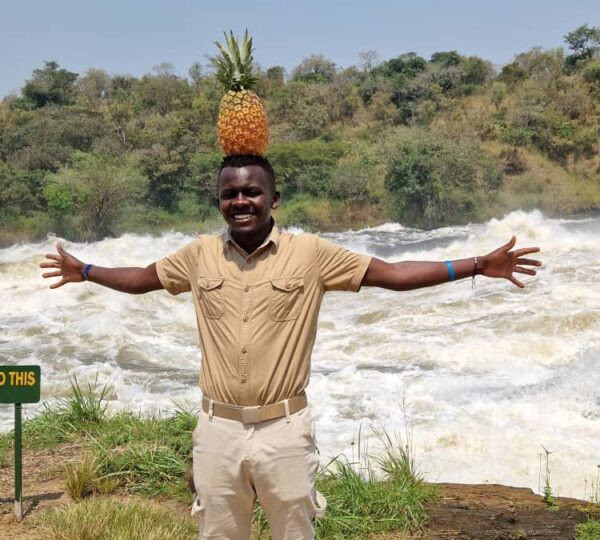
Murchison Falls
Standing at the top of Murchison Falls, looking down into the gorge where the entire Victoria Nile forces through a seven-metre gap in the rock, is one of the most dramatic viewpoints in Uganda, and the approach on foot through the forest gives a quality of arrival that driving to the top viewpoint cannot produce.
Budongo Forest at Kaniyo Pabidi
The Budongo Forest Reserve on the southern edge of Murchison Falls National Park, accessible from the Kaniyo Pabidi ecotourism site, gives a forest walking experience that is separate from the game drives on the north bank and is specifically productive for birding and primate observation.
The Budongo Forest contains a habituated chimpanzee community that can be tracked on a permit, but the walking safari experience in the forest itself, using the trail network around Kaniyo Pabidi, is worthwhile independently of the chimpanzee encounter.
The Royal Mile trail through the Budongo Forest is considered one of the finest birding walks in Uganda, covering a section of primary forest with exceptional bird diversity including several species not easily found elsewhere.
Mgahinga Gorilla National Park
Mgahinga Gorilla National Park on the slopes of the Ugandan Virunga volcanoes offers walking safari options that go beyond gorilla trekking and give access to the park’s unique combination of afromontane forest, bamboo zone, and Afroalpine vegetation at the higher elevations. The park covers 33.7 square kilometres, making it Uganda’s smallest national park, and every activity in it takes place on foot.
Volcano Hikes
The Mount Gahinga hike takes approximately six hours return from the park trailhead and climbs from the bamboo zone through Afroalpine moorland to the volcanic crater at the summit, which holds a small swamp and excellent views toward Mount Muhavura and across the Virunga Massif into Rwanda and the DRC.
Golden monkeys are reliably seen in the bamboo section of the ascent. The Mount Sabyinyo hike is more demanding, crossing the triple border point where Uganda, Rwanda, and the DRC meet at a single ridge, and takes eight to ten hours. The Muhabura hike is the most challenging of the three, at 4,127 metres the tallest of the Ugandan Virunga volcanoes, and requires camping at elevation for a two-day ascent.
The Batwa Cultural Trail
The Batwa Experience at Mgahinga is a guided forest walk led by Batwa community members who were displaced from what is now the park boundary in the early 1990s when the forest was gazetted as protected area.
The walk covers sections of the park’s forest that the Batwa used as their living and hunting grounds for generations, and the guides demonstrate forest knowledge, traditional plant use for food and medicine, honey collection from wild nests, and fire-making from natural materials.
The experience is one of the most significant cultural walking experiences in Uganda and one of the most honest: the guides share the reality of their displacement alongside the beauty of the forest they once lived in, and the combination of cultural knowledge and conservation history gives the Batwa walk a depth that most pure wildlife walks cannot match.
Semuliki National Park
Semuliki National Park in western Uganda, bordering the DRC near the town of Fort Portal, is one of Uganda’s least visited parks and one of its most rewarding for serious walking and birding. The park protects a section of lowland Congo Basin forest that extends across the border, and the bird species it holds include a significant number of Central African forest species found nowhere else in Uganda. The Sempaya Hot Springs, where boiling water erupts from the ground in two separate geothermal vents on the forest floor, are the most visited attraction and are accessible on a short walk from the trailhead.
The forest walking at Semuliki gives access to the park’s exceptional primate community including chimpanzees, olive baboons, grey-cheeked mangabeys, red-tailed monkeys, colobus, and the De Brazza’s monkey.
The lowland forest character is different from the highland forests of Bwindi and Kibale: the trees are different species, the understorey is denser, and the bird calls belong to a community that is partly Albertine Rift and partly Congo Basin.
A morning walk at Semuliki with a birding-focused guide produces a list of species that are simply not available anywhere else on the Uganda safari circuit, including the Nkulengu Rail, the Yellow-throated Nicator, and several sunbird species specific to the Congo lowland forest.